
 Posts
Posts





Tuesday, February 26, 2008
Sunday, February 3, 2008
Flyboys
more on the Eugene Bullard topic, from 11/10/07 from pseudo-intellectualism from wikipedia:
Flyboys is a 2006 drama film set during World War I, starring James Franco, Martin Henderson, Jean Reno, Jennifer Decker, David Ellison and Tyler Labine. It was directed by Tony Bill and written by David S. Ward, based on an original screenplay by Phil Sears and Blake Evans
The film follows the enlistment, training and aerial combat service of a group of young Americans who volunteer to become fighter pilots in the Lafayette Escadrille, the 124th air squadron formed by the French in 1916. The squadron consisted entirely of American volunteers who wanted to fly biplanes and fight in the First World War during the early years when the United States remained neutral.
The film was shot on location in the United Kingdom in Spring 2005 . The trench scenes were shot in Hatfield, Hertfordshire, the same location used for Band of Brothers and Saving Private Ryan. The airfield and aerial shots were filmed on and above RAF Halton (near Aylesbury) where hangers, mess rooms and officers quarters were built adjacent to Splash Covert woods. All were removed when filming ended.
The film was financed privately outside the standard Hollywood studio circuit by a group of filmmakers and investors, including producer Dean Devlin and pilot David Ellison, son of Oracle Corp. founder Larry Ellison; both spent more than $60 million of their own money to make and market Flyboys.
The Nieuport 17s featured in the film were built by Airdrome Aeroplanes, an aircraft company based outside of Kansas City, Missouri.
A group of young Americans go to France, for different personal reasons, and volunteer to fight in the French Air Service, the Aéronautique militaire, during World War I prior to America's entrance into the war. During the training period, the film mostly follows their personalities and developments; later, the focus shifts to the art of the aerial dogfight. Themes of revenge and love are also explored. The film ends with an explanation of what happened to each character, as the movie was based on real occurrences.
This film has been widely criticized for its lack of historical accuracy, anachronisms, and prochronisms. Various major details of World War 1 fighter aircraft technology shown in the film were highly inaccurate, even beyond typical Hollywood standards of accuracy. For example, the aircraft engines in the CGI scenes are pictured as not moving. The rotary engines used in early aircraft rotated along with the propeller at the same speed. The anti-aircraft artillery shown in use by the Germans was not of any type used by any side in the First World War, and those that did exist were not nearly as accurate as that shown. In reality, had any of the portrayed flak burst as close as it appeared in the film, the aircraft would have been most likely destroyed.[citations needed] One major point of contention in the film is the wide usage of Fokker Dr.I triplanes. Not only was the Dr.I not in usage at the time the film supposedly took place, when it was used it was not in such a large role, nor was it regularly painted red.In the film, the RMS Aquitania is depicted as a luxury liner, however, in early 1914 she was converted to use as an armed merchant cruiser, and by 1915 had been put into use as a troop transport ship and painted with dazzle style camouflage. Also, one scene describes the Germans as using a new 9mm caliber "Spandau" machine gun, even though no German machine gun was ever produced in 9mm, but rather in 7.92mm.
Lafayette Escadrille
from 11/11/07 from pseudo-intellectualism This is from a really good multi-part WWI documentary on youtube called The Great War In The Air. Notice how there's no mention of Eugene Bullard in this wiki entry:
The Lafayette Escadrille (from the French Escadrille De Lafayette) was a squadron of the French Air Service, the Aéronautique militaire, during World War I composed largely of American volunteer pilots flying fighters.
The squadron was formed in April 1916 as the Escadrille américaine (number 124) in Luxeuil prior to U.S. entry into the war. Dr. Edmund L. Gros, director of the American Ambulance Service, and Norman Prince, an American expatriate already flying for France, led the efforts to persuade the French government of the value of a volunteer American air unit fighting for France. The aim was to have their efforts recognized by the American public and thus, it was hoped, the resulting publicity would rouse interest in abandoning neutrality and joining the fight.
(In fact higher numbers of American volunteers served with the Royal Flying Corps, Royal Naval Air Service and Royal Air Force during the conflict.)
The squadron was quickly moved to Bar-le-Duc, closer to the front. A German objection filed with the U.S. government led to the name change in December over the actions of a supposed neutral nation. The original name implied that the U.S. was allied to France when it was in fact neutral like Sweden.
The planes, their mechanics, and the uniforms were French, as was the commander, Captain Georges Thenault. Five French pilots were also on the roster, serving at various times. Raoul Lufbery, a French-born American citizen, became the squadron's first, and ultimately their highest claiming, flying ace with 16 confirmed victories before his squadron was transferred to the US Air Services.
The first major action seen by the squadron was at the Battle of Verdun, being posted to the front in May 1916 until September 1916, when the unit moved to 7 Army area at Luxeuil. The squadron, flying the Nieuport scout, suffered heavy losses, but its core group of 38 was rapidly replenished by other Americans arriving from overseas. So many volunteered that a "Lafayette Flying Corps" was formed in part to take the overflow, many Americans thereafter serving with other French air units. Altogether, 265 American volunteers served in the Corps. Although not formally part of the Lafayette Escadrille, other Americans such as Michigan's Fred Zinn, who was a pioneer of aerial photography, fought as part of the French Foreign Legion and later the French Aéronautique militaire.
63 Corps members died during the war, 51 of them in action against the enemy. The Corps is credited with 159 enemy kills. It amassed 31 Croix de guerre, and its pilots were awarded seven Médailles militaires and four Légions d'honneur. 11 of its members were deemed flying aces, claiming 5 air kills or more. The core squadron suffered 9 losses and was credited with 41 victories.
The Escadrille had a reputation for daring, recklessness, and a party atmosphere.] Two lion cubs, named "Whiskey" and "Soda", were made squadron mascots.
Lufbery got into trouble for hitting an officer who was unwise enough to lay hands on him during an argument. He was rescued from jail by his squadron mates. He was a man after the heart of French ace Charles Nungesser who came calling on the escadrille during one of his convalescences. He borrowed a Spad and shot down another German plane even though he was officially grounded.
On February 8, 1918, the squadron was transferred to the United States Army Air Service as the 103rd Pursuit Squadron. For a brief period it retained its French planes and mechanics. Most of its veteran members were set to work training newly-arrived American pilots. The 103rd PS claimed a further 49 kills up until November 1918.
Members
* Hobey Baker
* Clyde Balsley
* Courtney Campbell
* Victor Chapman (1890-1916) The first American aviator to be killed in World War I
* Elliot C. Cowdin
* Marsh Corbitt (1890-1988) Ace
* Edmond Genet The first American flier to die after the United States declared war against Germany
* Bert Hall (1885-1948) Film Director, Actor, Writer & Lieutenant. Wrote two books about being a "Flyboy" in the Lafayette Escadrille.
* James Norman Hall (1887-1951), co-author of Mutiny on the Bounty
* Willis Haviland
* Walter Lovell
* Raoul Lufbery (1885-1918), an ace who died in combat
* Didier Masson (1886-1950)
* James R. McConnell
* Edwin C. "Ted" Parsons
* Norman Prince (1887-1916), Founder and ace
* Frederick H. Prince, Jr. (1885-1963)
* Kiffin Rockwell
* William Thaw
* Gill Robb Wilson
* A statue by the sculptor Gutzon Borglum titled The Aviator (1919) was erected on the grounds of the University of Virginia in Charlottesville, Virginia in the memory of James R. McConnell, a member of the squadron who was killed during the War. Before he was killed McConnell wrote a first-hand account of the war, Flying in France, that gives the reader invaluable insight into the war in France from 1915 until his death in 1917. Letters added to the end of the book include an account of McConnell's demise.
The story of the Lafayette Escadrille has been adapted into two films: Lafayette Escadrille (1958), a William A. Wellman movie starring Tab Hunter, and Flyboys (2006), directed by Tony Bill and starring James Franco. The Lafayette Escadrille also appears in "Attack of the Hawkmen," an episode of The Young Indiana Jones Chronicles in which Indy is temporarily assigned to the group as an aerial reconnaissance photographer.
The exploits of the Lafayette Escadrille are also captured in several works of historical fiction including: To the Last Man by Jeffrey Shaara,Valiant Volunteers by Terry L. Johnson (2005), and An Ace Minus One by Timothy Morrisroe (2006).
Follow up: an anonymous comment was left on the original posting in response to my
cynicism of why Eugene Bullard was not listed
"Notice how there's no mention of Eugene Bullard in this wiki entry:"
That's probably a good thing as Eugene Bullard was *never* in the Lafayette Escadrille (N.124 nor Spa.124). He was in the larger organization of Americans who flew for the French called the Lafayette Flying Corps. He flew with Spa.93 (The Lafayette Flying *Corps*) following his transfer from a French Foreign Legion Infantry unit. After fewer than 50 missions, Bullard ran into trouble with his superiors and was transferred back to the infantry. By first-hand accounts, Bullard was well-liked by his fellow fliers. You can find all the info you'd like in this book:Nordhoff, Charles and James Norman Hall. The Lafayette Flying Corps. Boston and New York: Houghton Mifflin Company, 1920. One of these guys (Hall) was in the Escadrille, the other (Nordhoff) flew in the Corps. I know that this contradicts the movie "Flyboys", but, c'est la vie.
Eugene Bullard In Harlem

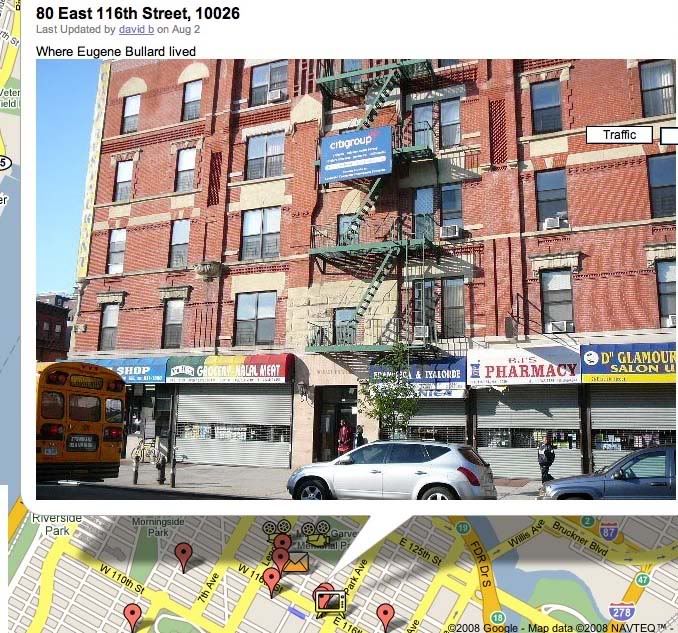
I recently watched the DVD of Flyboys. Despite poor reviews I found the film had redeeming qualities. It seemed that the character of the black pilot Skinner was based on Bullard. Research bore that out. I also found that Bullard lived in Harlem in his later years at 80 East 116th Street. Amazingly, with all the renovation that neighborhood has undergone the building is still there. That's a picture of it above. I would think the building deserves a plaque.
Eugene Bullard 3
from 11/10/07: The story of Eugene Bullard, whose WWI experiences were used as a basis for Flyboys
Eugene Bullard And Paul Robeson: Hold The Line
This is the Goggle Video version of the slide show that is linked to the previous post.
In the linked version the text is more visible
Eugene Bullard: On The Job

"Eugene Bullard was the world's first black combat aviator, flying in French squadrons during World War I (1917-18). Before he became a pilot he served in the French infantry and was awarded the Croix de Guerre. Born in a three-room house in Columbus, Eugene James (Jacques) Bullard was the seventh child of Josephine Thomas and William O. Bullard. Bullard's parents, married in Stewart County in 1882, had Creek Indian as well as African American ancestry. William Bullard was born a slave; his parents were the property of Wiley Bullard, a planter in Stewart County. In the early 1890s William Bullard moved to Columbus, where he worked for W. C. Bradley, a rising cotton merchant.
The young Bullard attended the Twenty-eighth Street School from 1901 to 1906. Although his education was minimal, he nonetheless learned to read, one of the keys to his later successes. With his older sister and brothers, Bullard absorbed his father's conviction that African Americans must maintain dignity and self-respect in the face of the prejudice of a white majority determined to "keep blacks in their place" at the bottom of society. Shaken by the near lynching of his father in 1903 and seeking adventure in the world beyond Columbus, he ran away from home in 1906. In Atlanta he joined a group of gypsies (an English clan known by the surname Stanley) and traveled with them throughout rural Georgia, tending and learning to race their horses. The Stanleys brought to his attention that the racial color line did not exist in England. Disheartened that the gypsies were not soon returning home, Bullard left them at their camp in Bronwood in 1909 and found work and patronage with the Zachariah Turner family of Dawson. Friendly and hard working as a stable boy, Bullard won the affection of the Turners, who allowed him to ride as their jockey in horse races at the Terrell County Fair in 1911.
Despite his relationship with the Turners, Bullard was still affronted by racism and he resolved to leave the United States for Great Britain. He did so as a stowaway on a German merchant ship, the Marta Russ, which departed Norfolk, Virginia, on March 4, 1912, bound for Aberdeen, Scotland. In 1912-14, Bullard performed in a vaudeville troupe and earned money as a prizefighter in Great Britain and elsewhere in Western Europe. He appeared in Paris for the first time at a boxing match in November 1913.
At the beginning of World War I, Bullard joined the French army, serving in the Moroccan Division of the 170th Infantry Regiment. The French government awarded him the Croix de Guerre for his bravery at the Battle of Verdun. Twice wounded and declared unfit for infantry service, he requested assignment to flight training. He amassed a distinguished record in the air, flying twenty missions and downing at least one German plane.Between the world wars he owned and managed nightclubs in the Montmartre section of Paris, where he emerged as a leading personality among such African American entertainers as Josephine Baker, Louis Armstrong, and Sidney Bechet. In 1923 he married Marcelle Straumann, the daughter of a wealthy Parisian family. The couple had two surviving children, Jacqueline and Lolita, before separating in 1931. In the late 1930s Bullard joined a French government counterintelligence network spying on Germans in Paris. When Nazi Germany conquered France in 1940 Bullard and his daughters escaped to New York City. He worked there in a variety of occupations for the rest of his life."
If you watched the slide show movie that accompanied the 4/19 "Hold The Line" post you would have seen Eugene Bullard being beaten by cretinous Peekskill thugs at the Paul Robeson concert in 1949. I had never heard of Mr. Bullard until then, but then I realized he has a chapter about him in the Scholastic book, "Black Eagles," which I've seen in several classrooms.
the reference to the 4/19 post along with linked slide shows
An excerpt from Howard Fast's eyewitness account of The Peekskill Riots:
"THE ATTACK STARTS A few minutes after I arrived, a boy came running down from the state road and informed us that the fascists had started the attack and that the road was solidly blocked. All the available boys and men--about 25--ran up to the entrance to the grounds. There we discovered that the double entrance had been blocked, one part with a Legion truck, the other with a stone barricade. As we stood there, the fascists launched their first attack, about 300 of them against our handful. There was a brief melee, in which two of our boys were hurt, quite badly. We noticed now that most of the attackers were heavily liquored up; nor were they teen-age boys, as so many stories reported. Most of them were men between 35 and 50--and one of their leaders was identified as a prominent real estate man of Peekskill. At this point, three sheriffs appeared. They were in plain clothes, with gold badges pinned on. Aside from three other men--who were identified as Justice Department agents, and who stood quietly by--these were the only police we on the inside saw for the next two and a half hours. The three sheriffs argued half-heartedly with the fascists; one of them with sufficient guts could have broken up the thing right there; but all three, in all their actions, were against us and on the side of the fascists. While the sheriffs argued, we formed ourselves into three lines, sending the girls back to the bandstand [leaving the males] stretched across the road, which was embanked at this point. There were exactly 42 of us, and we organized into seven groups of six, with a squad leader for each group. We were about half Negro and half white, half teen-age boys, and half men. We had eight trade unionists among us, four of them merchant seamen. From here on, for the next two hours, we maintained our discipline."
I would say even odds that George Pataki's father was part of that lynch mob Here's the full text of Fast's account and as a rare two for one bonus Here's a slide show I put together consisting of archival images of the concert/riots, some recent pictures of the same site (now a luxury Toll Bros. condo with an adjoing golf course). The sound track is the stirring Pete Seeger/Lee Hays song (not to be confused with Toto's), "Hold The Line"


