
 Posts
Posts





Friday, February 29, 2008
Addisleigh Park In Queens
a slide show I made (the original is bigger and more viewable) of many of the historic homes I pinpointed on my Queens Jazz Trail Map. The nusic is "Flying Home" by the Lionel Hampton band featuring former Addisleigh Park resident and great tenor sax player Illinois Jacquet
from a great nyc history site forgotten-ny
Southern Queens' ascendance as a mecca for jazz musicians began in 1923 when Clarence Williams, a successful musician and entrepreneur from Plaquemine, Louisiana, purchased a home and eight lots at 171-37 108th Avenue. Anticipating the increasing popularity of jazz in the north, Williams moved first to Chicago in 1920 and then to New York with his wife, singer Eva Taylor, in 1923. Desiring open spaces reminiscent of his upbringing in the Louisiana delta, Williams made his home in Queens. He would be the first in a lengthy line of jazz musicians to come to southern Queens.
Addisleigh Park is a small part of the larger St. Albans neighborhood in Queens. Addisleigh is mostly clustered in the named streets (unusual for Queens) located north, south and west of Farmers and Linden Boulevards.
There are precious few memorials to St. Albans/Addisleigh Park's jazz heritage. This now-fading mural on the northern side of Linden Boulevard as it passes under the Long Island Railroad depicts many of the jazz and entertainment giants who resided here.
Having grown up in New Jersey, Count Basie arrived in NYC in 1923 and joined Fats Waller's (see below) band as an organist in 1924. After playing with Benny Moten's band, forging a new swing-based sound in Kansas City in 1927, he returned to the big apple in 1936 as the leader of the Count Basie Orchestra, which featured Lester Young and Herschell Evans on sax, trumpeters Buck Clayton and Harry Edison and vocalists Billie Holiday, Jimmy Rushing and Helen Humes. Their residence at the Woodside Hotel in Harlem inspired 1938's "Jumpin' at the Woodside."
Count Basie's home on Adelaide Road and 175th Street, St. Albans
In the 50s, Basie formed a new band that included the new sound of bebop and more blues-y elements. Basie's pop hits include "One O'Clock Jump," "Blue Skies," and the #1 "Open the Door, Richard!" in 1947; in 1963 he enjoyed a Top Five album with Frank Sinatra, "Sinatra-Basie." Count Basie moved to the new neighborhood of Addisleigh Park in 1946.
ELLA FITZGERALD (1918-1996)
"Among all of us who sing, Ella was the best". -- Johnny Mathis
"I never knew how good our songs were until I heard Ella Fitzgerald sing them."
--Ira Gershwin
Ella Fitzgerald performed for 58 years, won 13 Grammy Awards and sold in excess of 40 million records. "The First Lady of Song" was born in Newport News, VA, and was orphaned young in life. She was discovered in an amateur contest sponsored by Harlem's famed Apollo Theatre in 1934 and was soon the featured vocalist in Chick Webb's band.
Ella lived on Murdock Avenue between 179th and 180th Street. She moved to Addisleigh Park in the 1950s. "I was delighted when Ella moved here. I could go up to her bar at her house and drink up all of her whiskey, and then go through somebody's yard and go home."Illinois Jacquet
Ella enjoyed her first big smash in 1938 with "A-Tisket, a Tasket" and led Webb's band for three years after his death in 1939. After enjoying dozens of hits on the Decca label, including "I'm Making Believe" in 1944, "I Love You For Sentimental Reasons" in 1946 and "Baby, It's Cold Outside" with Louis Jordan in 1949, Ella moved on the the new Verve label in 1955 and reinterpreted classics by Cole Porter, Duke Ellington and Rodgers and Hart on albums featuring Nelson Riddle arrangements.
MILT HINTON (1910-2000)
The dean of jazz bassists, "The Judge" was born in Vicksburg, Mississippi and moved to Chicago with his family in 1921. After working through the 1920s a s afreelance musician with such legendary jazz artists including Zutty Singleton, Jabbo Smith, Eddie South, Erskine Tate, and Art Tatum, he joined Cab Calloway's band in 1936, remaining with Cab for 15 years. Milt Hinton lived at 113th Avenue and Marne Place.Hinton was a Queens resident from 1950 until his death in 2000.
Striking out on his own in the early 1950s, Hinton went on to play on thousands of recordings and toured extensively, performing with such giants as Louis Armstrong, Bing Crosby, Charles Mingus, John Coltrane, and even pop musicans such as Bette Midler and Paul McCartney. Milt Hinton was also an educator and author, teaching at Hunter and Baruch Colleges. He also became an exhibited photographer, having taken over 60,000 images from his years on the road; many were published in his his book "Bass Line."
Fats Waller was reportedly the first African American to live in Addisleigh Park. He resided at Sayres Avenue and 174th Street. His home had a built-in Hammond organ and a Steinway grand. His derby tilted rakishly to one side, Fats Waller plinked the 88s and dotted his playful, high-spirited jazz-pop songs with bawdy ad-libs. Waller, one of the 1930s' consummate crowd-pleasers, was born in Greenwich Village in 1904, was playing piano by ear at age six, and at his reverend father's encouragement, learned violin, bass violin and organ. Waller got his professional start at 'rent parties' (where admission was charged to help out with rent payments) and vaudeville. In 1927, he collaborated on his first hit show, "Keep Shufflin'", and his next show, "Hot Chocolates" contained his first big hit, "Ain't Misbehavin.'" Waller went on to score and perform in dozens of shows. His biggest hit, "It's a Sin to Tell a Lie", came in 1936, and he wrote and performed time-tested classics like "Honeysuckle Rose," The Joint Is Jumpin,'" and "Lulu's Back in Town." Waller suffered from drinking and overweight problems his entire life. He also considered himself a serious musician, but racism in the period prevented him from realizing these ambitions. Soon after finishing work in "Stormy Weather" in 1943 he collapsed and died of bronchial pneumonia.
LENA HORNE (1917-)
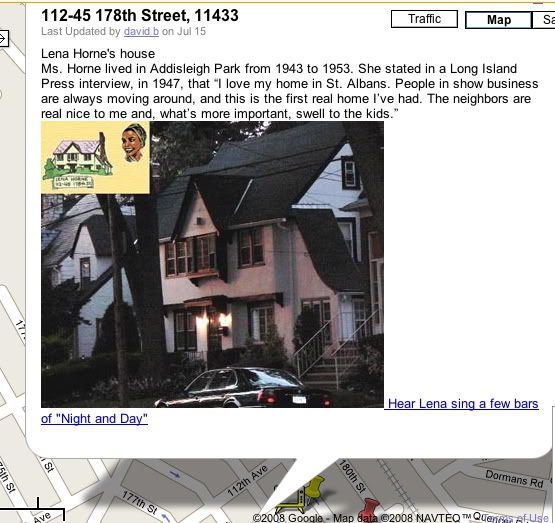
Lena Horne was born in Brooklyn in 1917 and has been performing since she was a teenager. She danced and later sung at the Cotton Club beginning in 1933 and made her first recordings in 1937 with Teddy Wilson's orchestra. She joined Charlie Barnet's orchestra in 1940, and while Barnet's behavior was exemplary (he was one of the first white bandleaders to hire African Americans) she tired of the draining segregation and racism that was such a constant durng that time. Upon signing with MGM in 1940, she shrewdly had a clause written in that prevented her from depicting domestics, in a jungle native role, or other cliché images. Her appearance in 1943's Stormy Weather was a sensation; her rendition of the title song was her biggest hit and remains her signature song. Lena Horne left Hollywood in the early fifties to concentrate on her singing. Like many of her contemporaries, Lena Horne resided at 178th Street between 112th Avenue and Murdock Avenue beginning in the 1940s. During the Joe McCarthy era, she was blacklisted for her left-wing associations, but in 1956 she was taken off the list and resumed her career. She found great success during the sixties and seventies. In 1981, she appeared on Broadway in her own show, Lena Horne: The Lady and Her Music, which became the longest-running one-woman show in the history of Broadway. She continues recording to this day. Lena Horne lives in New York City.
Saxophonist John Coltrane, who along with Charlie Parker is regarded by many fans as the greatest jazz performer in history, lived on Mexico Street near Quencer Road; Mercer Ellington, Duke's son, who took over the Ellington Orchestra after his father's death and wrote Duke's biography, lived on 175th Street near 113th Avenue; saxophonist Eddie "Lockjaw" Davis, Foch Boulevard near 171st Street; saxophonist Illinois Jacquet and his brother, trumpeter Russell Jacquet, in nearby houses on 179th Street near 112th Avenue; and saxophonist Earl Bostic, pianist/organist Wild Bill Davis, bassist Slam Stewart, trumpeter Cootie Williams, saxophonist Oliver Nelson, drummer James "Osie" Johnson, saxophonist Lester Young, and singer Rose Murphy also lived in St. Albans. In the 1960s, The Godfather of Soul, James Brown, lived in this house which formerly belonged to Bart Williams, trumpeter with Duke Ellington, on Linden Boulevard and 176th Street , and Brook Benton (who sung one of your webmaster's favorite songs, "A Rainy Night In Georgia", and wrote "A Lover's Question" and "The Stroll,") lived on Murdock Avenue near 175th Street.
Thursday, February 21, 2008
Lena Horne
A short clip from the 1943 movie "Cabin In The Sky"
Stormy Weather lyrics
Don't know why, there's no sun up in the sky
Stormy weather, since my man and I ain't together
Keeps raining all the time
Life is bare, gloom and misery everywhere
Stormy weather, just can't get my poor old self together
I'm weary all the time, the time, so weary all of the time
When he went away, the blues walked in and met me
If he stays away, old rocking chair will get me
All I do is pray, the lord above will let me
walk in the sun once more
Can't go on, everything I had is gone
Stormy weather, since my man and I ain't together
Keeps raining all the time
Keeps raining all of the time
I walk around heavy-hearted and sad
Night comes around and I'm still feeling bad
Rain pourin' down, blinding every hope I had
This pitter andd n patter and beating, spattering driving me mad
Love, love, love, love, the misery will be the end of me
When he went away, the blues walked in and met me
If he stays away, old rocking chair will get me
All I do is pray, the lord above will let me
Walk in the sun once more
Can't go on, everything I had is gone
Stormy weather, since my man and I ain't together
Keeps raining all the time, the time
Keeps raining all the time
Wednesday, February 20, 2008
Google Maps: Lena Horne
from my google map of Homes of Famous Brooklynites and Other Places of Interest
from wikipedia
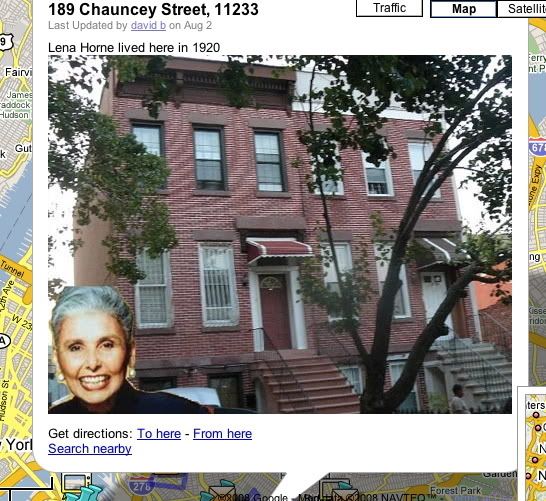
Helena Mary Calhoun Horne (born June 30, 1917), is a singer and actor of African-American, Caucasian, and Cherokee descent. She has recorded and performed extensively, independently and with other jazz notables, including Artie Shaw, Teddy Wilson, Billy Strayhorn, Duke Ellington, and Charlie Barnett. She currently lives in New York City and no longer makes public appearances.
Lena Horne was born in Bedford-Stuyvesant, Brooklyn, New York, and grew up in an upper middle class black community. Her father, Edwin "Teddy" Horne, who worked in the gambling trade, left the family when she was three. Her mother, Edna Scottron, was the daughter of inventor Samuel R. Scottron; she was an actress with an African American theater troupe and traveled extensively. Horne was mainly raised by her grandparents, Cora Calhoun and Edwin Horne. Her uncle, Frank S. Horne, was an adviser to Franklin Delano Roosevelt. She is a reported descendant of the John C. Calhoun family .
Lena Horne made her film debut starring as "the Bronze Venus" in The Duke is Tops, a 1938 musical.
Lena Horne made her film debut starring as "the Bronze Venus" in The Duke is Tops, a 1938 musical.
After a false start headlining a 1938 musical race movie called The Duke is Tops, Horne became the first African American performer to sign a long-term contract with a major Hollywood studio, namely Metro-Goldwyn-Mayer. She made her debut with MGM in 1942's Panama Hattie and became famous in 1943 for her rendition of "Stormy Weather" in the movie of the same name (which she made while on loan to 20th Century Fox from MGM).
She appeared in a number of MGM musicals, most notably Cabin in the Sky (also 1943), but was never featured in a leading role due to her race and the fact that films featuring her had to be reedited for showing in southern states where theaters could not show films with African American performers. As a result, most of Horne's film appearances were stand-alone sequences that had no bearing on the rest of the film, so editing caused no disruption to the storyline; a notable exception was the all-black musical Cabin in the Sky, though even then one of her numbers had to be cut because it was considered too suggestive by the censors. In Ziegfeld Follies (1946) she performs "Love" by Hugh Martin and Ralph Blane.
She was originally considered for the role of Julie LaVerne in MGM's 1951 version of Show Boat (having already played the role when a segment of Show Boat was performed in Till the Clouds Roll By) but Ava Gardner was given the role instead (the production code office had banned interracial relationships in films). In the documentary That's Entertainment! III Horne stated that MGM executives required Gardner to practice her singing using recordings of Horne performing the songs, which offended both actresses (ultimately, Gardner ended up having her singing voice overdubbed by another actress for the theatrical release, though her own voice was heard on the soundtrack album).
By the mid-1950s, Horne was disenchanted with Hollywood and increasingly focused on her nightclub career. She only made two major appearances in MGM films during the decade, 1950's Duchess of Idaho (which was also Eleanor Powell's film swan song), and the 1956 musical Meet Me in Las Vegas. She was blacklisted during the 1950s for her political views.[4] She returned to the screen three more times, playing chanteuse Claire Quintana in the 1969 film Death of a Gunfighter, Glinda in The Wiz (1978), and co-hosting the 1994 MGM retrospective That's Entertainment! III, in which she was candid about her treatment by the studio. In her later years, Horne also made occasional television appearances - generally as herself - on such programs as The Muppet Show (where she sang with Kermit the Frog) and Sanford and Son in the 1970s, as well as a 1985 performance on The Cosby Show and a 1993 appearance on A Different World.
She appeared in Broadway musicals several times and in 1958 was nominated for the Tony Award for "Best Actress in a Musical" (for her part in the "Calypso" musical Jamaica) In 1981 she received a Special Tony Award for her one-woman show, Lena Horne: "The Lady and Her Music". Despite the show's considerable success (Horne still holds the record for the longest-running solo performance in Broadway history), she was not inclined to capitalize on the renewed interest in her career by undertaking many new musical projects. A proposed 1983 joint recording project between Horne and Frank Sinatra (to be produced by Quincy Jones) was ultimately abandoned, and her sole studio recording of the decade was 1988's The Men In My Life, featuring duets with Sammy Davis, Jr. and Joe Williams. In 1989, she received the Grammy Lifetime Achievement Award.
The 1990s found Horne considerably more active in the recording studio - all the more remarkable considering she was approaching her 80th year. Following her 1993 performance at a tribute to the musical legacy of her good friend Billy Strayhorn (Duke Ellington's) longtime pianist and arranger), she decided to record an album largely comprised of Strayhorn's and Ellington's songs the following year, We'll Be Together Again. To coincide with the release of the album, Horne made what would be her final concert performances at New York's Supper Club and Carnegie Hall. That same year, Horne also lent her vocals to a recording of "Embraceable You" on Sinatra's "Duets II" album. Though the album was largely derided by critics, the Sinatra-Horne pairing was generally regarded as its highlight. In 1995, a "live" album capturing her Supper Club performance was released (subsequently winning a Grammy Award for Best Jazz Vocal Album). In 1998, at the age of 81, Horne released another studio album, entitled Being Myself. Thereafter, Horne essentially retired from performing and largely retreated from public view, though she did return to the recording studio in 2000 to contribute vocal tracks on Simon Rattle's Classic Ellington album.
Horne also is noteworthy for her contributions to the Civil Rights movement. In the 1940s, she sang at Cafe Society and worked with Paul Robeson, a singer who also combated American racial discrimination. During World War II, when entertaining the troops at her own expense, she refused performing "for segregated audiences or to groups in which German POWs were seated in front of African American servicemen" , according to her Kennedy Center biography. She became better known during the Civil Rights movement, participating in the March on Washington and speaking and performing in behalf of the NAACP and the National Council for Negro Women. She also worked with Eleanor Roosevelt to pass anti-lynching laws.
In 2003, ABC announced that Janet Jackson would star as Horne in a television biopic (after it was rumored for years that Whitney Houston would take the job). In the weeks following Jackson's "wardrobe malfunction" debacle during the 2004 Super Bowl, however, Variety reported that Horne demanded Jackson be dropped from the project. "ABC executives resisted Horne’s demand," according to the Associated Press report, "but Jackson representatives told the trade newspaper that she left willingly after Horne and her daughter, Gail Lumet Buckley, asked that she not take part." Oprah Winfrey stated to Alicia Keys during a 2005 interview on The Oprah Winfrey Show that she might possibly consider producing the biopic herself, casting Keyes as Horne.
In January 2005, Blue Note Records, her label for more than a decade, announced that "the finishing touches have been put on a collection of rare and unreleased recordings by the legendary Horne made during her time on Blue Note. Remixed by her longtime producer Rodney Jones, the recordings featured Horne in remarkably secure voice for a woman of her years, and include versions of such signature songs as 'Something To Live For', 'Chelsea Bridge' and 'Stormy Weather'." The album, originally titled Soul but renamed Seasons of a Life, was released on January 24, 2006.
Horne was married first to Louis Jones, by whom she had a daughter, Gail and a son, Edwin.
Lena Horne's second marriage was to Lennie Hayton, a Jewish American, from 1947 until his death in 1971. Hayton was one of the premier musical conductors and arrangers at MGM. In her as-told-to autobiography Lena by Richard Schickel, Horne recounts the enormous pressures she and her husband faced as an interracial married couple. However, she later admitted (Ebony, May 1980) that she really married Hayton to advance her career and cross the "color-line" in show business. She is also a member of Delta Sigma Theta Sorority, Incorporated.
Subscribe to:
Posts (Atom)


