
 Posts
Posts





Sunday, March 7, 2010
Thursday, February 28, 2008
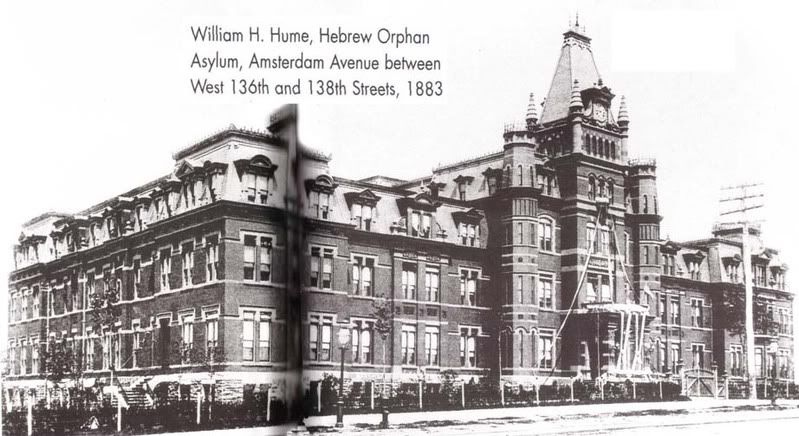
Harlem's Orphan Asylums
the setting for Dave At Night. The writer Art Buchwald was a resident of this Asylum.
In addition, back in 1920 the site was once considered to be the location for the first Yankee Stadium.
from A HISTORICAL TOUR OF THE GREATEST STREET IN THE WORLD.......BROADWAY
FROM NINETY-SIXTH STREET TO ONE HUNDRED AND SIXTY-EIGHTH STREET
CHARITABLE SOCIETIES LOCATED IN THE AREA OF BROADWAY.
Attracted by the salubrity and healthfulness of Washington Heights,
several charitable societies located among the country estates, on or near
the old road or upon Broadway.
A) THE SHELTERING ARMS
It was organized in 1864 for homeless children between five and twelve years
of age for whom no other institution provides, is at Amsterdam Avenue and
One Hundred and Twenty-ninth Street.
B) THE HEBREW ORPHAN SOCIETY
It was founded in 1822, is on the same avenue at One Hundred and
Thirty-sixth Street.
C) THE MONTEFIORE HOME
At Broadway and One Hundred and Thirty-eighth Street is one of the grandest
charities in the city, the Hospital and Home for Chronic Invalids, commonly
called the "Montefiore Home." It was founded in 1884 and is supported
almost entirely by the voluntary subscriptions from people of the Jewish
faith, as a memorial to the famous philanthropist, Sir Moses Montefiore; it
is open to both sexes without distinction of race or creed. The present
quarters have been found to be too cramped to carry out fully the desires of
the trustees, and arrangements are already completed to transfer the Home to
the Borough of The Bronx on the Gunhill Road near Jerome Avenue. The new
buildings are to cost $1,500,000, and will be designed to accommodate six
hundred invalids, with all modern improvements for their comfort and health.
D) THE COLORED ORPHAN ASYLUM
It was organized in 1837, was for many years at Amsterdam Avenue and One
Hundred and Forty-third Street until its removal to Mount St. Vincent. At
the time of the draft riots of July, 1863, the asylum was located at Fifth
Avenue between Forty-third and Forty-fourth streets. The malice of the
rioting crowds was directed against every one who showed color, whether
man, woman, or child, and many negroes were hanged from near-by lamp-posts.
Inspired by this hatred, the mob made an attack upon the asylum and fired
the buildings, which were consumed; but fortunately, the children were
withdrawn safely through a rear entrance. With the money obtained as damages
from the city, that secured from the sale of the Fifth Avenue plot, and that
subscribed by citizens, many of whom had never heard of the institution
until the burning of the asylum, the new buildings were started on
Washington Heights.
Tuesday, February 26, 2008
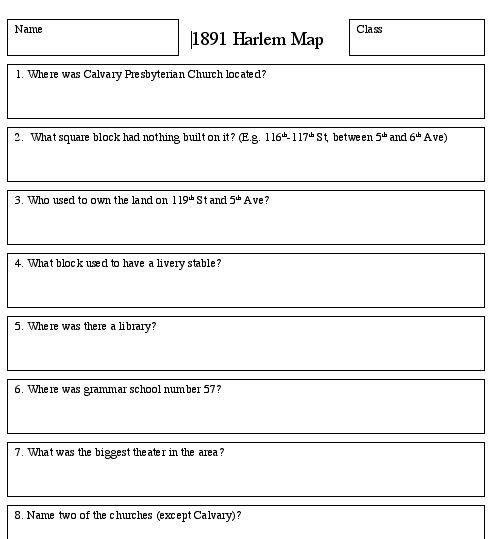
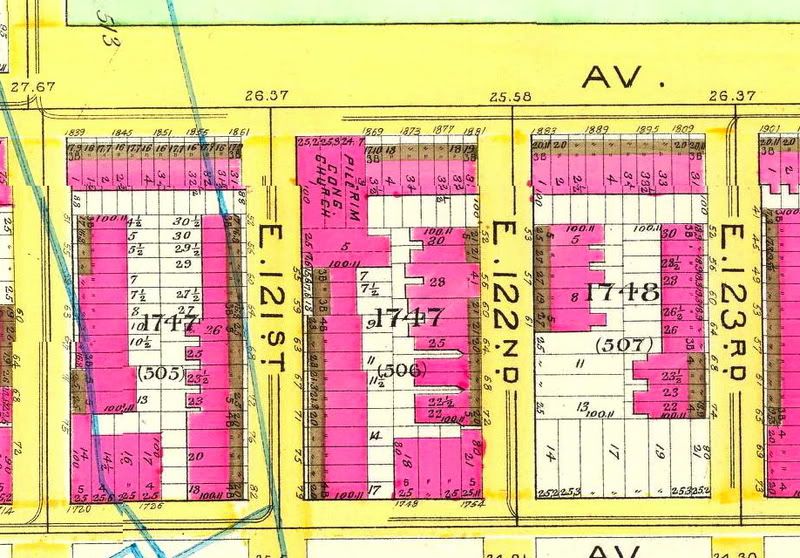
Assignment Template For 1891 Real Estate Map Of Harlem
Monday, February 25, 2008
Althea Gibson: How I Discovered Her Address In Harlem
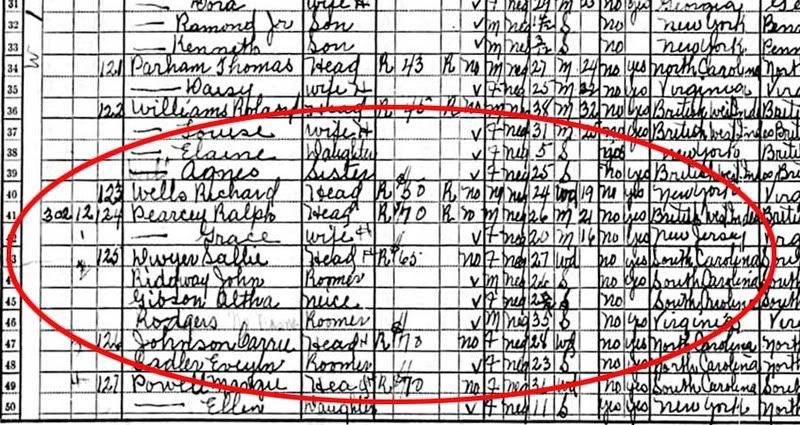
I wasn't aware of Althea living in Harlem until I read her biography. I looked in the 1930 census for an Althea Gibson living in Harlem and found none. I then tried looking just for a Gibson (thinking that Althea may have been spelled incorrectly) who was three years old and originally born in South Carolina. Bingo! I found an Altha Gibson, age 3, born in South Carolina, living at 302 West 146th Street. She was living with an aunt named Sallie Dwyer and their rent was $65 (which seems pretty high by 1930 standards).
Tuesday, February 19, 2008
My Google Maps: Duke Ellington And The 1930 Census
here's a link to my google map on harlem where the image below comes from.
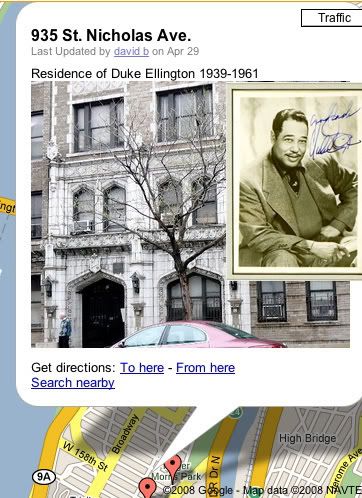
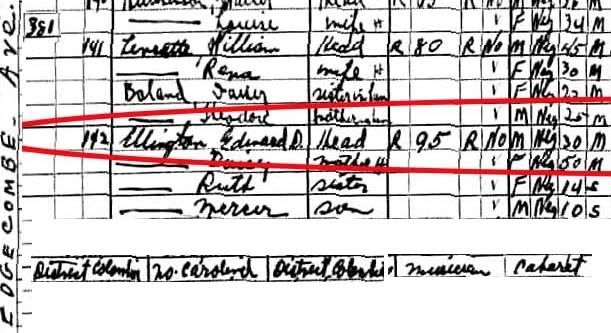
According to Ephemera Press' Harlem map Duke Ellington lived at 935 St. Nicholas Ave. However in the 1930 census I found him living at 381 Edgecombe Ave., apt. 142. He lived there with his mother Daisy, his sister Ruth and his son Mercer.
Sunday, February 17, 2008
Maxine Sullivan: The 1930 Census As Alice M. Williams?

"In interviews given before her death, Maxine Sullivan liked to tell the story of how the pint-size daughter of a barber from Homestead, a small town near Pittsburgh, achieved international acclaim as a jazz singer.
During her late teens, after winning local singing contests and performing with her uncle’s band, she landed a gig at an eight-table former speakeasy in Pittsburgh called the Benjamin Harrison Literary Club. Singing from table to table, she earned $14 a week plus tips.
One night in late 1936, a pianist named Gladys Mosier came by the club and encouraged Ms. Sullivan to try her singing where it really mattered, in New York. It took Ms. Sullivan six months to save up enough for a weekend excursion ticket, and she told no one that she was going, figuring that she’d probably be back in Pittsburgh in time for her regular engagement."
Well, there were no Marietta Williams in all of Pa, so I did a search for M Williams. My other search option was to put in an age which would have been 19 in 1930. Still no luck, but there were some Williams' with M as a middle initial who were 19 in a Pittsburgh county. Through trial and error (eliminating those that were White) I came up with the above. According to the article her father was a barber, not a plumber as listed. I don't know which is correct. A good clue that this could be her is that in the census it says she works as a clerk in a book store, which would be a cover for someone who is a singer in a speakeasy "front" called the Benjamin Harrison Literary Club.
Friday, February 15, 2008
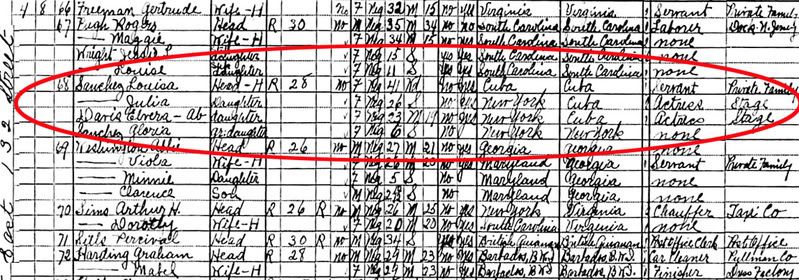
Sammy Davis, Jr.: Harlem And Cuban Roots


Thursday, February 7, 2008
Cab Calloway In The 1930 Census
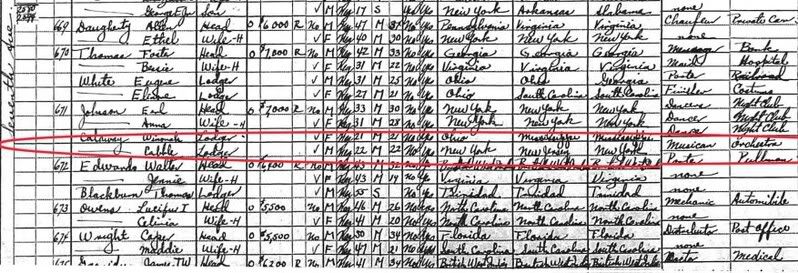
Cab (Cabble Calaway) was 22 years old and working as a musician in an orchestra. He and his wife/sister ?, Wimonah, age 21 and a dancer, were boarders of Earl and Anna Johnson who were also dancers. The yearly rent of their apartment #671, in the Dunbar, was $7000 a year or approximately $580 a month
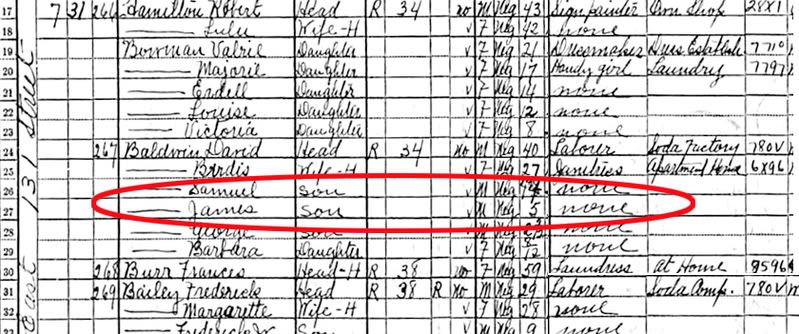
James Baldwin In Harlem In The 1930 Census
I haven't added this yet to my Harlem Map, i.e. primary documents images of the addresses of where various Harlem luminaries lived. This one is of James Baldwin.
from wikipedia:
James Arthur Baldwin (August 2, 1924 – November 30, 1987) was an American novelist, writer, playwright, poet, essayist, and civil rights activist.
Most of Baldwin's work deals with racial and sexual issues in the mid-20th century United States. His novels are notable for the personal way in which they explore questions of identity as well as for the way in which they mine complex social and psychological pressures related to being black and homosexual well before the social, cultural or political equality of these groups could be assumed.[1]
Baldwin was born in 1924, the first of his mother's nine children.[2] He never met his biological father and may never have even known the man's identity.[3] Instead, he considered his stepfather, David Baldwin, as his father figure. David, a factory worker and a store-front preacher, was allegedly very cruel at home.[4] While his father opposed his literary aspirations,[5] Baldwin found support from a teacher as well from the mayor of New York City, Fiorello H. LaGuardia. At age 14, Baldwin joined the small Fireside Pentecostal Church in Harlem. After he graduated from DeWitt Clinton High School in the Bronx, he moved to Greenwich Village, where he concentrated more on his literary career.
One source of support came from an admired older writer Richard Wright, whom he called "the greatest black writer in the world for me." Wright and Baldwin became friends for a short time and Wright helped him to secure the Eugene F. Saxon Memorial Award. Baldwin titled a collection of essays Notes of a Native Son, in clear reference to Wright's novel Native Son.[citation needed] However, Baldwin's 1949 essay "Everybody's Protest Novel" ended the two authors' friendship[6] because Baldwin asserted that Wright's novel Native Son, like Harriet Beecher Stowe's Uncle Tom's Cabin, lacked credible characters and psychological complexity. However, during an interview with Julius Lester, [7] Baldwin explained that his adoration for Wright remained: "I knew Richard and I loved him. I was not attacking him; I was trying to clarify something for myself."
Another major influence on Baldwin's life was the African-American painter Beauford Delaney. In The Price of the Ticket (1985), Baldwin describes Delaney as "the first living proof, for me, that a black man could be an artist. In a warmer time, a less blasphemous place, he would have been recognized as my teacher and I as his pupil. He became, for me, an example of courage and integrity, humility and passion. An absolute integrity: I saw him shaken many times and I lived to see him broken but I never saw him bow."
Baldwin was closely befriended with singer, pianist and civil rights activist Nina Simone. Together with Langston Hughes and Lorraine Hansberry, Baldwin is responsible for making Simone aware of the racial inequality at the time and the groups that were forming to fight against this. He also provided her with literary references to expand her knowledge on this point.
Baldwin left to live in Europe for an extended period of time beginning in 1948.[8][9] His first destination was Paris. When Baldwin returned to the United States, he became actively involved in the Civil Rights Movement.[10] He marched with Martin Luther King, Jr. to Washington, D.C.[11] During the early 1980s, Baldwin was on the faculty of the Five Colleges in Western Massachusetts. While there, he mentored Mount Holyoke College future playwright Suzan-Lori Parks, who won the Pulitzer Prize for Drama in 2002. Baldwin did not remain in the United States long, however, and he was a repeated expatriate for the rest of his life, spending long stints in Istanbul, Turkey[12] and in St.-Paul-de-Vence in Southern France, where he died of esophageal cancer in 1987 at the age of 63.
In 1953, Baldwin's first novel, Go Tell It on the Mountain, an autobiographical bildungsroman, was published. Baldwin's first collection of essays, Notes of a Native Son, appeared two years after. Baldwin continued to experiment with literary forms throughout his career, publishing poetry and plays as well as the fiction and essays for which he was known.
Baldwin's second novel, Giovanni's Room, stirred controversy when it was first published in 1956 due to its explicit homoerotic content.[13] Baldwin was again resisting labels with the publication of this work:[14] despite the reading public's expectations that he would publish works dealing with the African American experience, Giovanni's Room is exclusively about white characters.[15] Baldwin's next two novels, Another Country and Tell Me How Long the Train's Been Gone, are sprawling, experimental works[citation needed] dealing with black and white characters and with heterosexual, homosexual, and bisexual characters.[citation needed] These novels struggle to contain the turbulence of the 1960s:[citation needed] they are saturated with a sense of violent unrest and outrage.[citation needed]
Baldwin's lengthy essay Down at the Cross (frequently called The Fire Next Time after the title of the book in which it was published)[citation needed] similarly showed the seething discontent of the 1960s in novel form. The essay was originally published in two oversized issues of The New Yorker and landed Baldwin on the cover of Time magazine in 1963 while Baldwin was touring the South speaking about the restive Civil Rights movement. The essay talked about the uneasy relationship between Christianity and the burgeoning Black Muslim movement. Baldwin's next book-length essay, No Name in the Street, also discussed his own experience in the context of the later 1960s, specifically the assassinations of three of his personal friends: Medgar Evers, Malcolm X, and Martin Luther King, Jr.
Baldwin's writings of the 1970s and 1980s have been largely overlooked by critics. The assassinations of black leaders in the 1960s as well as Eldridge Cleaver's vicious homophobic attack on Baldwin in Soul on Ice, along with his return to southern France, contributed to the sense that he was not in touch with his readership. Always true to his own convictions rather than to the tastes of others, Baldwin continued to write what he wanted to write. His two novels written in the 1970s, If Beale Street Could Talk and Just Above My Head, placed a strong emphasis on the importance of black families, and he concluded his career by publishing a volume of poetry, Jimmy's Blues, as well as another book-length essay, The Evidence of Things Not Seen, which was an extended meditation inspired by the Atlanta Child Murders of the early 1980s.
Baldwin's influence on other writers has been profound: Toni Morrison edited the Library of America editions of Baldwin's fiction and essays, and a recent collection of critical essays links these two writers.
In 1987, Kevin Brown, a photo-journalist from Baltimore, MD founded the National James Baldwin Literary Society. The group organizes free public events celebrating Baldwin's life and legacy.


