Thursday, February 28, 2008

The Hebrew Home For Boys

from 5/8/06 from pseudo-intellectualism

When Dave Caros' father dies in "Dave At Night" he is sent to live at the Hebrew Home For Boys in Harlem. This institution existed on 136th Street, between Broadway and Amsterdam until the 1930's. I couldn't find any pictures of it online. I wanted to get some images of the area to show the classes involved in the les/harlem project that I envisioned. I decided to combine some atmospheric sound with the images, but came up a bit short. So in this slide show I augmented that soundtrack with some reggaetone music. I hadn't been in that area much (CCNY takes up a big part) in my life, other some PS 397K era trips to 142nd Street and Hamilton Place (The Children's Art Carnival). The Convent and Edgecombe Ave areas were beautiful. I had thought that the latin area of west Harlem started further uptown than the 130's. The dividing line between latin and African-American Harlem seemed to be CCNY and St Nicholas Park. Amazingly, the exact location of the Home was discovered when I was researching the Jacob Schiff School, which is unique in that you have to climb a hill to reach it from its 136th Street side. Here's what I found on the nycparks dept site:"This parkland, which is shared by Public School 192, also known as Jacob H. Schiff School, was once home to the Hebrew Orphan Asylum. By World War II, the orphan asylum closed and was transformed into army barracks. Shortly after the war, City College acquired the building for use as a classroom and dormitory, naming it “Army Hall.” The building eventually closed in 1952 and was demolished when Parks and the Board of Education jointly acquired the land in 1956. In 1987, the Schiff School playground received a $918,623 renovation and was officially named Jacob H. Schiff Playground

LES Harlem Connection

from 5/6/06 from pseudo-intellectualism

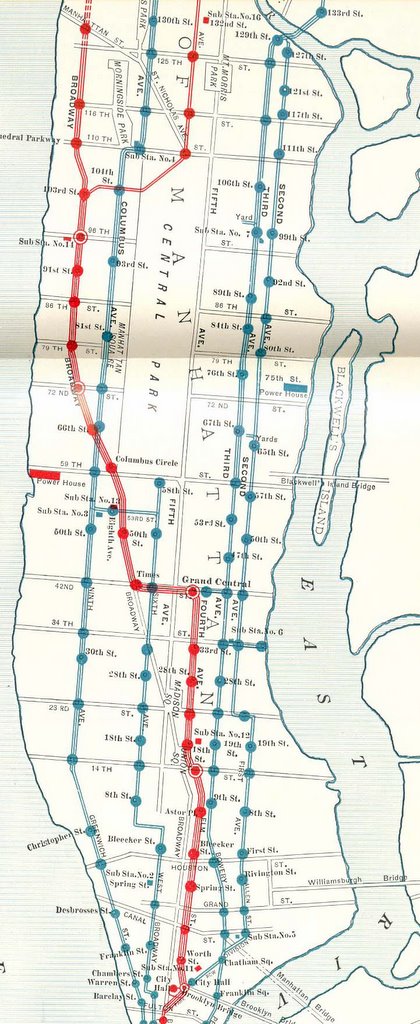
Here I'll try to explain the synchronicity referred to before. I'll begin working up in Harlem in a little while. I've been planning a Harlem Renaissance unit. In looking for children's literature to support this topic I discovered, "Dave At Night." I found it amazing that Dave's story closely paralled my own family history. Dave Karos' father came from Greece, he was a Sephardic Jew. So did my grandfather, who was named David Belelis. Dave Karos' family came from Salonika, my grandfather came from neighboring Janina. The main reason for immigration was the same-a war over control of the territory between Turkey and Greece. Dave Karos' father died in a fall in building accident. My grandfather died almost the same way in an elevator collapse. Dave was left fatherless at 8, My own father was left fatherless at 10. Dave went to an orphanage. My father didn't, but my aunt on my mother's side did when my mother's father died father in 1926 (the same year that Dave's father dies). Pretty spooky, isn't it? I'm "migrating" my work location from the LES to Harlem as Dave is migrated his life. The experience of the early immigrants to the LES at the turn of the last century is that once they were able to secure some economic stability for themselves they moved to a better neighborhood, Harlem. Why Harlem? Ease of transportation, IRT Elevated Lines connected the areas. Many people continued to work on the LES, but lived in Harlem. Wouldn't it be great to get the Harlem School I'll be working in do a joint immigration/migration project with some kids from PS42? They can even read Dave At Night together digitally. They can visit each other's neighborhood and do walking tours. On Friday,after a year and a half, I visited principal Rosa O'Day again and explained my plan and she loved it. I love her. The map attached is a 1904 subway and trolley map. Click on it to expand it. The trolley lines are in blue.

Dave At Night

from 1/13/06 from pseudo-intellectualism

The main character of this book attends PS42 on Hester Street. Here's a portion of the review: "In Dave at Night, Newbery Honor award– winning author Gail Carson Levine brilliantly describes in gritty detail an orphan’s journey from loss to fulfillment. Fans of her previous novel, Ella Enchanted, might be surprised at Gail Carson Levine's departure from the world of fantasy with her realistic new book, Dave at Night. Inspired by Ms. Levine's father's experience in the Hebrew Orphan Asylum in New York, this is the story of eleven-year-old Dave Caros. The year is 1926. Dave’s beloved father is dead, and his stepmother doesn’t want him. Only the HHB will take him in. Hebrew Home for Boys, aka Hell Hole for Brats. Dave is tough, a troublemaker. He can take care of himself. If he doesn’t like the Home, he’ll run away and find a better place. Only it’s not that simple. . . .This stunning new novel by Newbery Honor award–winning author Gail Carson Levine takes Dave from the poverty of the Lower East Side of New York City to the misery of the Hebrew Home for Boys to the hope and magic of Harlem during the Harlem Renaissance. It tells a tale of terrible loss and hard-won gains, of cruel relations and kind strangers, of great poverty and great wealth. Most of all, though, it tells a tale about the power of friendship." Here's the first few chapters as a slide show. I'm on my way to whole book. What's great about this book is that it has an audio version. Here's a segment as an mp3.

Tuesday, February 19, 2008

Catherine Street Eel Market


from 11/30/07 from pseudo-intellectualism

The cartoon images from the slide show come from Patrick Reynold's great collection
of New York City history called the Big Apple Almanac
There was once an active eel market on Catherine Slip in the 1800's. Black citizens engaged in a form of minstrelsy to earn a living and perhaps a free meal. The slide show is padded with an excerpt from an 1889 nytimes article about the area:

A Rodgers and Hart work:
Hawks and crows do lots of things,
but the canary only sings.
She is a courtesan on wings-
So I've heard.
Eagles and storks are twice as strong.
All the canary knows is song.
But the canary gets along-
Guilded bird!
REFRAIN
Sing for your supper,
And you'll get breakfast.
Songbirds always eat
If their song is sweet to hear.
Sing for your luncheon,
And you'll get dinner.
Dine with wine of choice,
If romance is in your voice.
I heard from a wise canary
Trilling makes a fellow willing,
So, little swallow, swallow now.
Now is the time to
Sing for your supper,
And you'll get breakfast.
Songbirds are not dumb,
They don't buy a crumb
Of bread,
It's said.
So sing and you'll be fed.

Tuesday, February 5, 2008

St Augustine's Episcopal Church 2


historic images from the St. Augustine Church web site combined with go tell it on the mountain
lyrics:

Go tell it on the mountain
Over the hills and everywhere
Go tell it on the mountain
That Jesus Christ is born
Go tell it on the mountain
Over the hills and everywhere
Go tell it on the mountain
That Jesus Christ is born
While shepherds kept their watching
Over silent flocks by night
Behold through out the Heavens
There shown a Holy light
Go tell it on the mountain
Over the hills and everywhere
Go tell it on the mountain
That Jesus Christ is born
Oh, down in a lowly manger
The humble Christ was born
And brougt us God's salvation
That blessed Christmas morn'
Go tell it on the mountain
Over the hills and everywhere
Go tell it on the mountain
That Jesus Christ is born

St Augustine's Episcopal Church


A church with a great piece of black history. From the nytimes of 2/26/06

Rediscovering a Relic of a Past Long Obscured By KATHARINE GREIDER
FOR the longest time, no one disturbed the two boxlike enclosures at the rear of the balcony in St. Augustine's Episcopal Church.
No one went up there in the 1950's, when on Sundays Diane (later Afiya) Dawson walked with her mother to the church, an old stone building on Henry Street on the Lower East Side. Or the 60's, when a nun drew Rodger Taylor, a student at nearby Public School 110, into the life of the church. Or in the 70's, when Valerie Preston, as a newlywed, found her way to the vibrant black congregation where she and her husband would take two babies to be baptized.
But by the late 90's, gentrification on the Lower East Side was renewing an old story, the one of African-Americans being, if not pushed out of the neighborhood, somehow made invisible. The Rev. Errol A. Harvey encouraged parishioners to make a connection with the cramped rooms in the upstairs of his church: It was time to climb the impossibly narrow, winding stair that led to the place where their 19th-century black forebears had been confined, literally hidden from the view of white parishioners who filled the main pews. It was time to confront that place, and reveal it to the world.
Before and for a time after 1827, the year slavery was abolished in New York State, white churches typically assigned black people to rear pews or upper galleries like those at St. Augustine's. Continuing an oral tradition that reaches back almost a century, St. Augustine's members call its haunting spaces slave galleries.
In 1999, St. Augustine's formed a committee to study the galleries, a group led by the deacon, the Rev. Edgar W. Hopper, and including Ms. Dawson, Mr. Taylor and Ms. Preston. For three years, this committee collaborated with the Lower East Side Tenement Museum, which provided fund-raising help and historical research, and emerged with a plan to restore the space and open it for tours. The project has already cost about $270,000; an additional $400,000 is needed to complete restoration.
As part of the rediscovery of this place, some longtime parishioners entered the tiny chambers for the first time. "I felt, I remember very sharply, that it was a sacred space," said Ms. Preston, a school social worker. "I could feel a presence of the ancestors, like there were hundreds of people in the room." It was a sense, she said, of "hearing music, hearing voices."
"I mean, it was overwhelming."
Galleries like this are rare. There is one other known example in Lower Manhattan, in the First Chinese Presbyterian Church, which predates St. Augustine's.
Were the occupants of these rough benches taken to church as servants, soothing and shushing their white infant charges, perhaps, in that stifling perch? Or were they free people who went to talk with God on their own account? Possibly both.
The year a group of prosperous white businessmen founded what was then All Saints' Episcopal Church — 1824 — and the year its present building opened — 1828 — straddle a day of profound significance across New York State: July 4, 1827, Emancipation Day.
Given the fact that St. Augustine's opened after slavery ended in New York, some historians have objected to the term "slave galleries." But Mr. Hopper and his committee say the phrase reveals a deep truth about the space and the mind-set of those who built it. They point to the only two founding vestrymen located in the 1820 census, both slaveholders at a time when fewer than 2,000 New Yorkers were enslaved. Even after emancipation, legally enslaved people could be found in New York, traveling with Southern masters or hiding from them in the city's busy African-American communities.
It is also possible some early occupants of the galleries were still indentured, or continued to be perceived as slaves even though they were free, suggests Leslie M. Harris, author of "In the Shadow of Slavery: African Americans in New York, 1626-1863."' Writing home in 1831 from Pennsylvania, where blacks had been free for decades, de Tocqueville's traveling companion Gustave de Beaumont observed that "laws don't change customs."
And yet emancipation would have been vitally important to the African-Americans who climbed up to these seats, a truth that also seems to sing from the historical record of this venerated church. All Saints' earliest sacramental lists revealed the names of several apparently free black parishioners, including Henry Nichols, who in 1830 was head of a household of 10 free black people. He made saddles for a living and lived at 11 Lewis Street, a few blocks from the church.
WITH his wife, Phoebe, and three of their children, he went to All Saints' on July 5, 1829, to be baptized. This, Mr. Hopper recognized, was a day black New Yorkers took to the streets in celebration of the second anniversary of emancipation.
There was something else unusual about the incident: "Episcopalians are brought to be baptized in swaddling clothes; it's not something we do late in life," Mr. Hopper said. "This was a conversion, you understand?" It may be that the Nicholses were making a connection between baptism and the "conversion" from slavery to freedom, for their community and perhaps members of their own household. For centuries, slaveholders and enslaved people had been in tension over the rite of baptism, both perceiving it as a door to freedom. To reassure slaveholders, colonial legislatures, including New York's, had passed laws establishing that a slave baptized as a Christian could still be held in bondage.
At All Saints', the era of both the Nicholses and the patrician founders didn't last. Blacks increasingly left segregated white churches for their own houses of worship. The Lower East Side filled with poor European immigrants, and All Saints' with Irish tenement dwellers. In 1924, an ebbing All Saints' (by the 1940's it would merge with St. Augustine's and begin its transition to black stewardship) celebrated its hundredth anniversary with a drama that included these lines:
Slave: O Massa, am I gwine to be forgot? Alone for me is there no room in Heav'n?
All Saints': Come in dear Negro Slave, you too may come; for you I build two special galleries, where you, locked in, may join in all the hymns and shout Amen! to what your Masters pray.
Later in the drama, New York's governor enters, and, with a tap of his sword, emancipates the kneeling slave, who exclaims, "Glory, glory, hallelujah, freedom!"
In the 1920's, classifieds in The New York Times advertised All Saints' as "the slave-gallery church," complete with "Lincoln Museum," as if, from this safe cultural and historical distance, the space could now be seen as an attraction or curiosity.
The uncovering of St. Augustine's past is a work in progress. But to leave its graciously proportioned sanctuary for one of those galleries is a visceral experience that by itself conveys a great deal. "The power of this," says Mr. Taylor, a co-author of the book "Einstein on Race and Racism," "is that you can share it with people. People can come in and get an experience. Otherwise, it's just two rooms."

blogger templates | Make Money Online