
Saturday, March 6, 2010

History Talk: Tonya Bolden's Maritcha: A 19th Century American Girl, Part 2


n February 9, 2010. Sponsored by Telling America's Story

Telling America's Story (TAS) is an intensive, federally-funded professional development project for American History Teachers in elementary, middle, and high schools in the Bronx Community School Districts 8, 11, & 12. Philip Panaritis and Brian Carlin, Project Directors. TAS is a partnership with the New York City Department of Education and the history and education departments of major universities and cultural institutions.
The program combines content-rich traditional American History and teaching skills development for Teacher-Historians. Workshops take place in museums, historic houses, and universities. Instruction and content is provided by nationally-known historians and educators. Teachers develop original US history curriculum units and activities. Trips, book signings, and walking tours of historical sites are also important aspects of the TAS program. Ms. Bolden had visited many of the classes of the teachers gathered here. Behind her are samples of projects made by some of those classes.
About Ms. Bolden
Growing up, Tonya Bolden thought one day she would be a teacher. Today, as an award-winning author of more than 20 books for young people and adults, she is just that. Her classroom has no walls. Instead, you just need to pick up one her acclaimed books on topics such as the Rev. Dr. Martin Luther King, Jr., George Washington Carver or Reconstruction to step into the world she creates. History, she has said, is her passion. She passes that rich knowledge of the past on to people around the world. Along with being a talented researcher, Bolden is known as a gifted storyteller who turns facts into something more transcendent stories that move, challenge and inspire.

about Maritcha:
from the book flap:
To do the best for myself with the view of making the best of myself. wrote Maritcha Remond Lyons about her childhood.
Maritcha was born in New York City in 1848. For most of her youth, she and her family lived in lower Manhattan. Much of Maritcha's life there mirrored that of many children of the time: helping with the housework, attending school, and practicing the piano. Yet there were thrilling occasions as well, such as visiting the Crystal Palace, site of Americas first worlds fair. However, Maritcha's life took a dramatic turn in 1863, when, at the age of fifteen, she and her family had to flee from their home in the midst of the violent Draft Riots. They eventually resettled in Providence, Rhode Island, where Maritcha triumphantly overcame prejudice to become the first black person to graduate from Providence High School.
Based on an unpublished memoir by Ms. Lyons ~ Memories of Yesterdays: All of Which I Saw and Part of Which I Was, dated 1928 ~ the evocative text and photographs of young Maritcha, her family, and their friends, as well as archival maps, photographs, and illustrations, make this book an invaluable cultural and historical resource. Maritcha brings to life the story of a very ordinary yet remarkable girl of nineteenth-century America.
»» James Madison Book Award Winner
»» Coretta Scott King Author Honor Book
»» YALSA Best Book for Young Adults
»» ALSC Notable Childrens Book
History Talk: Tonya Bolden's Maritcha: A 19th Century American Girl, Part 1


On February 9, 2010. Sponsored by Telling America's Story

Telling America's Story (TAS) is an intensive, federally-funded professional development project for American History Teachers in elementary, middle, and high schools in the Bronx Community School Districts 8, 11, & 12. Philip Panaritis and Brian Carlin, Project Directors. TAS is a partnership with the New York City Department of Education and the history and education departments of major universities and cultural institutions.
The program combines content-rich traditional American History and teaching skills development for Teacher-Historians. Workshops take place in museums, historic houses, and universities. Instruction and content is provided by nationally-known historians and educators. Teachers develop original US history curriculum units and activities. Trips, book signings, and walking tours of historical sites are also important aspects of the TAS program. Ms. Bolden had visited many of the classes of the teachers gathered here. Behind her are samples of projects made by some of those classes.
About Ms. Bolden
Growing up, Tonya Bolden thought one day she would be a teacher. Today, as an award-winning author of more than 20 books for young people and adults, she is just that. Her classroom has no walls. Instead, you just need to pick up one her acclaimed books on topics such as the Rev. Dr. Martin Luther King, Jr., George Washington Carver or Reconstruction to step into the world she creates. History, she has said, is her passion. She passes that rich knowledge of the past on to people around the world. Along with being a talented researcher, Bolden is known as a gifted storyteller who turns facts into something more transcendent stories that move, challenge and inspire.

about Maritcha:
from the book flap:
To do the best for myself with the view of making the best of myself. wrote Maritcha Remond Lyons about her childhood.
Maritcha was born in New York City in 1848. For most of her youth, she and her family lived in lower Manhattan. Much of Maritcha's life there mirrored that of many children of the time: helping with the housework, attending school, and practicing the piano. Yet there were thrilling occasions as well, such as visiting the Crystal Palace, site of Americas first worlds fair. However, Maritcha's life took a dramatic turn in 1863, when, at the age of fifteen, she and her family had to flee from their home in the midst of the violent Draft Riots. They eventually resettled in Providence, Rhode Island, where Maritcha triumphantly overcame prejudice to become the first black person to graduate from Providence High School.
Based on an unpublished memoir by Ms. Lyons ~ Memories of Yesterdays: All of Which I Saw and Part of Which I Was, dated 1928 ~ the evocative text and photographs of young Maritcha, her family, and their friends, as well as archival maps, photographs, and illustrations, make this book an invaluable cultural and historical resource. Maritcha brings to life the story of a very ordinary yet remarkable girl of nineteenth-century America.
»» James Madison Book Award Winner
»» Coretta Scott King Author Honor Book
»» YALSA Best Book for Young Adults
»» ALSC Notable Childrens Book

Thursday, March 4, 2010

The JT Project Reaches Out In Harlem

Connecting Jazz to Harlem's Youth from Olivia Manders on Vimeo.


Harlem and jazz share a rich history. For it to remain history – and nothing more – for younger Harlem audiences is a problem that one jazz band is seeking to remedy.

Todd is the son of my friend and former Knickerbocker Village neighbor, Murray Schefflin and his lovely wife Arlene.

Tuesday, January 5, 2010

365 Days Of Black History: January

Black History Calendar 1
datebook calendar and images from the library of congress

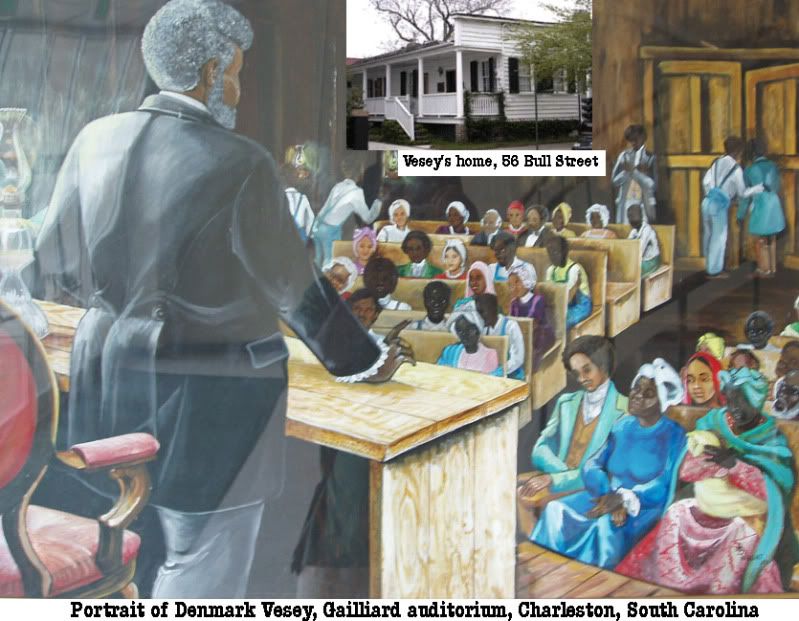
Denmark Vesey


image above, except for insert, is from Denmark Vesey.org site information below is
from the African American Registry

December 31 celebrates the life of Denmark Vesey in 1767. He was a self-educated black abolitionist who planned the most extensive slave revolt in U.S. history, in Charleston, S.C. in 1822.
Born in St. Thomas, the Danish West Indies, he was sold in 1781 to a Bermuda slave captain named Joseph Vesey. Young Denmark, who assumed his master's surname, accompanied him on numerous voyages and in 1783 settled with his owner in Charleston.
In 1799, Vesey was allowed to purchase his freedom with $600 he had won in a street lottery. He was already familiar with the great Haitian slave revolt of the 1790s, and while working as a carpenter he read anti-slavery literature. Dissatisfied with his second-class status as a freedman and determined to help relieve the far more oppressive conditions of others he knew, Vesey planned and organized an uprising of city and plantation blacks.
The plan reportedly called for the rebels to attack guardhouses and arsenals, seize their arms, kill all Whites, burn and destroy the city, and free the slaves. As many as 9,000 Blacks may have been involved, though some scholars dispute this figure. Warned by a house servant, White authorities on the eve of the scheduled outbreak made massive military preparations, which forestalled the rebellion. During the ensuing two months, some 130 Blacks were arrested.
In the trials that followed, 67 were convicted of trying to raise an insurrection; of these, 35, including Vesey, were hanged, July 2, 1822, in Charleston and 32 were condemned to exile. In addition, four White men were fined and imprisoned for encouraging the plot.

a h/t to Sean Ahern for making aware of the African American Registry site

Saturday, November 28, 2009

Claudette Colvin: The "Real" Rosa Parks 2


Claudette Colvin: Twice Toward Justice by Author Phillip Hoose
On March 2, 1955, an impassioned teenager, fed up with the daily injustices of Jim Crow segregation, refused to give her seat to a white woman on a segregated bus in Montgomery, Alabama. Instead of being celebrated as Rosa Parks would be just nine months later, fifteen-year-old Claudette Colvin found herself shunned by her classmates and dismissed by community leaders.
Undaunted, a year later she dared to challenge segregation again as a key plaintiff in Browder v. Gayle, the landmark case that struck down the bus segregation laws of Montgomery and swept away the legal underpinnings of the Jim Crow South.
Based on extensive interviews with Claudette Colvin and many others, Phillip Hoose presents the first in-depth account of an important yet largely unknown civil rights figure, skillfully weaving her dramatic story into the fabric of the historic Montgomery bus boycott and court case that would change the course of American history.

Claudette Colvin: The "Real" Rosa Parks

claudette-colvin
The images above feature Claudette Colvin. The images of her taken on a bus was part of a municipal bus decoration project done in her honor by school children of Portland, Maine.
an excerpt from the nytimes

From Footnote to Fame in Civil Rights History, By BROOKS BARNES
On that supercharged day in 1955, when Rosa Parks refused to give up her bus seat to a white passenger in Montgomery, Ala., she rode her way into history books, credited with helping to ignite the civil rights movement.
But there was another woman, named Claudette Colvin, who refused to be treated like a substandard citizen on one of those Montgomery buses — and she did it nine months before Mrs. Parks. The Rev. Dr. Martin Luther King Jr. made his political debut fighting her arrest. Moreover, she was the star witness in the legal case that eventually forced bus desegregation.
Yet instead of being celebrated, Ms. Colvin has lived unheralded in the Bronx for decades, initially cast off by black leaders who feared she was not the right face for their battle, according to a new book that has plucked her from obscurity.
Last week Phillip Hoose won the National Book Award for Young People’s Literature for “Claudette Colvin: Twice Toward Justice,” published by Farrar, Straus & Giroux. The honor sent the little-selling title shooting up 500 spots on Amazon.com’s sales list and immediately thrust Ms. Colvin, 70, back into the cultural conversation.
“Young people think Rosa Parks just sat down on a bus and ended segregation, but that wasn’t the case at all,” Ms. Colvin said in an animated interview at a diner near her apartment in the Parkchester section of the Bronx. “Maybe by telling my story — something I was afraid to do for a long time — kids will have a better understanding about what the civil rights movement was about.”
Ms. Colvin made her stand on March 2, 1955, and Mrs. Parks made hers on Dec. 1 that same year. Somehow, as Mrs. Parks became one of Time Magazine’s 100 most important people of the 20th century, and streets and schools were named after her, Ms. Colvin managed to let go of any bitterness. After Ms. Colvin was arrested, Mrs. Parks, a seasoned N.A.A.C.P. official, sometimes let her spend the night at her apartment. Ms. Colvin remembers her as a reserved but kindly woman who fixed her snacks of peanut butter on Ritz crackers.
“My mother told me to be quiet about what I did,” Ms. Colvin recalled. “She told me: ‘Let Rosa be the one. White people aren’t going to bother Rosa — her skin is lighter than yours and they like her.’ ”
Ms. Colvin said she came to terms with her “raw feelings” a long time ago. “I know in my heart that she was the right person,” she said of Mrs. Parks.
Unlike Mrs. Parks, whose protest was carefully planned, Ms. Colvin was just a 15-year-old who couldn’t stomach the Jim Crow segregation laws one second longer.
Ms. Colvin was riding the bus home from school when the driver demanded that she give up her seat for a middle-age white woman, even though three other seats in the row were empty, one beside Ms. Colvin and two across the aisle.
“If she sat down in the same row as me, it meant I was as good as her,” Ms. Colvin said.
Two police officers, one of them kicking her, dragged her backward off the bus and handcuffed her, according to the book. On the way to the police station, they took turns trying to guess her bra size.
At the time, the arrest was big news. Black leaders, among them Dr. King, jumped at the opportunity to use her case to fight segregation laws in court. “Negro Girl Found Guilty of Segregation Violation” was the headline in The Alabama Journal. The article said that Ms. Colvin, “a bespectacled, studious looking high school student,” accepted the ruling “with the same cool aloofness she had maintained” during the hearing.
As chronicled by Mr. Hoose, more than 100 letters of support arrived for Ms. Colvin — sent in care of Mrs. Rosa Parks, secretary of the Montgomery branch of the N.A.A.C.P.
But Ms. Colvin was ultimately passed over.
“They worried they couldn’t win with her,” Mr. Hoose said in an interview from his home in Portland, Me. “Words like ‘mouthy,’ ‘emotional’ and ‘feisty’ were used to describe her.”

Isn't it embarrassing the schoolchildren of Portland, Maine honor Bronx native Claudette and nothing has been done in Bloomberg and Klein's Broad Prize Award Winning public school system of New York. Social Studies and history is paid short shrift in the so-called greatest city. It is only done well by inspired and brave leaders and teachers in far few schools that risk side-stepping the all day, every day test prep mantra.
for more on Phil Hoose's award winning book

blogger templates | Make Money Online