
 Posts
Posts





Black History Calendar 1
datebook calendar and images from the library of congress
Tuesday, January 5, 2010
Denmark Vesey
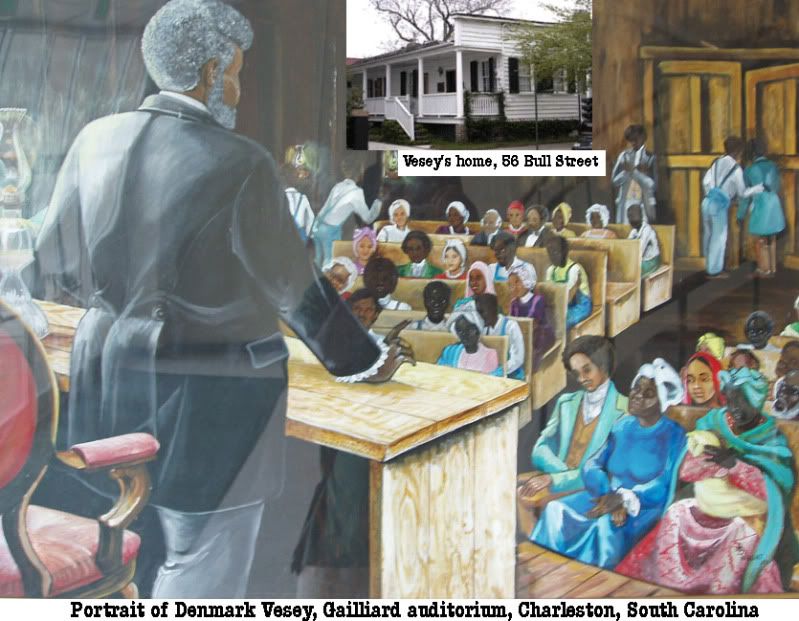
image above, except for insert, is from Denmark Vesey.org site information below is
from the African American Registry
December 31 celebrates the life of Denmark Vesey in 1767. He was a self-educated black abolitionist who planned the most extensive slave revolt in U.S. history, in Charleston, S.C. in 1822.
Born in St. Thomas, the Danish West Indies, he was sold in 1781 to a Bermuda slave captain named Joseph Vesey. Young Denmark, who assumed his master's surname, accompanied him on numerous voyages and in 1783 settled with his owner in Charleston.
In 1799, Vesey was allowed to purchase his freedom with $600 he had won in a street lottery. He was already familiar with the great Haitian slave revolt of the 1790s, and while working as a carpenter he read anti-slavery literature. Dissatisfied with his second-class status as a freedman and determined to help relieve the far more oppressive conditions of others he knew, Vesey planned and organized an uprising of city and plantation blacks.
The plan reportedly called for the rebels to attack guardhouses and arsenals, seize their arms, kill all Whites, burn and destroy the city, and free the slaves. As many as 9,000 Blacks may have been involved, though some scholars dispute this figure. Warned by a house servant, White authorities on the eve of the scheduled outbreak made massive military preparations, which forestalled the rebellion. During the ensuing two months, some 130 Blacks were arrested.
In the trials that followed, 67 were convicted of trying to raise an insurrection; of these, 35, including Vesey, were hanged, July 2, 1822, in Charleston and 32 were condemned to exile. In addition, four White men were fined and imprisoned for encouraging the plot.
a h/t to Sean Ahern for making aware of the African American Registry site
Saturday, November 28, 2009
Claudette Colvin: The "Real" Rosa Parks 2
Claudette Colvin: Twice Toward Justice by Author Phillip Hoose
On March 2, 1955, an impassioned teenager, fed up with the daily injustices of Jim Crow segregation, refused to give her seat to a white woman on a segregated bus in Montgomery, Alabama. Instead of being celebrated as Rosa Parks would be just nine months later, fifteen-year-old Claudette Colvin found herself shunned by her classmates and dismissed by community leaders.
Undaunted, a year later she dared to challenge segregation again as a key plaintiff in Browder v. Gayle, the landmark case that struck down the bus segregation laws of Montgomery and swept away the legal underpinnings of the Jim Crow South.
Based on extensive interviews with Claudette Colvin and many others, Phillip Hoose presents the first in-depth account of an important yet largely unknown civil rights figure, skillfully weaving her dramatic story into the fabric of the historic Montgomery bus boycott and court case that would change the course of American history.
Claudette Colvin: The "Real" Rosa Parks
claudette-colvin
The images above feature Claudette Colvin. The images of her taken on a bus was part of a municipal bus decoration project done in her honor by school children of Portland, Maine.
an excerpt from the nytimes
From Footnote to Fame in Civil Rights History, By BROOKS BARNES
On that supercharged day in 1955, when Rosa Parks refused to give up her bus seat to a white passenger in Montgomery, Ala., she rode her way into history books, credited with helping to ignite the civil rights movement.
But there was another woman, named Claudette Colvin, who refused to be treated like a substandard citizen on one of those Montgomery buses — and she did it nine months before Mrs. Parks. The Rev. Dr. Martin Luther King Jr. made his political debut fighting her arrest. Moreover, she was the star witness in the legal case that eventually forced bus desegregation.
Yet instead of being celebrated, Ms. Colvin has lived unheralded in the Bronx for decades, initially cast off by black leaders who feared she was not the right face for their battle, according to a new book that has plucked her from obscurity.
Last week Phillip Hoose won the National Book Award for Young People’s Literature for “Claudette Colvin: Twice Toward Justice,” published by Farrar, Straus & Giroux. The honor sent the little-selling title shooting up 500 spots on Amazon.com’s sales list and immediately thrust Ms. Colvin, 70, back into the cultural conversation.
“Young people think Rosa Parks just sat down on a bus and ended segregation, but that wasn’t the case at all,” Ms. Colvin said in an animated interview at a diner near her apartment in the Parkchester section of the Bronx. “Maybe by telling my story — something I was afraid to do for a long time — kids will have a better understanding about what the civil rights movement was about.”
Ms. Colvin made her stand on March 2, 1955, and Mrs. Parks made hers on Dec. 1 that same year. Somehow, as Mrs. Parks became one of Time Magazine’s 100 most important people of the 20th century, and streets and schools were named after her, Ms. Colvin managed to let go of any bitterness. After Ms. Colvin was arrested, Mrs. Parks, a seasoned N.A.A.C.P. official, sometimes let her spend the night at her apartment. Ms. Colvin remembers her as a reserved but kindly woman who fixed her snacks of peanut butter on Ritz crackers.
“My mother told me to be quiet about what I did,” Ms. Colvin recalled. “She told me: ‘Let Rosa be the one. White people aren’t going to bother Rosa — her skin is lighter than yours and they like her.’ ”
Ms. Colvin said she came to terms with her “raw feelings” a long time ago. “I know in my heart that she was the right person,” she said of Mrs. Parks.
Unlike Mrs. Parks, whose protest was carefully planned, Ms. Colvin was just a 15-year-old who couldn’t stomach the Jim Crow segregation laws one second longer.
Ms. Colvin was riding the bus home from school when the driver demanded that she give up her seat for a middle-age white woman, even though three other seats in the row were empty, one beside Ms. Colvin and two across the aisle.
“If she sat down in the same row as me, it meant I was as good as her,” Ms. Colvin said.
Two police officers, one of them kicking her, dragged her backward off the bus and handcuffed her, according to the book. On the way to the police station, they took turns trying to guess her bra size.
At the time, the arrest was big news. Black leaders, among them Dr. King, jumped at the opportunity to use her case to fight segregation laws in court. “Negro Girl Found Guilty of Segregation Violation” was the headline in The Alabama Journal. The article said that Ms. Colvin, “a bespectacled, studious looking high school student,” accepted the ruling “with the same cool aloofness she had maintained” during the hearing.
As chronicled by Mr. Hoose, more than 100 letters of support arrived for Ms. Colvin — sent in care of Mrs. Rosa Parks, secretary of the Montgomery branch of the N.A.A.C.P.
But Ms. Colvin was ultimately passed over.
“They worried they couldn’t win with her,” Mr. Hoose said in an interview from his home in Portland, Me. “Words like ‘mouthy,’ ‘emotional’ and ‘feisty’ were used to describe her.”
Isn't it embarrassing the schoolchildren of Portland, Maine honor Bronx native Claudette and nothing has been done in Bloomberg and Klein's Broad Prize Award Winning public school system of New York. Social Studies and history is paid short shrift in the so-called greatest city. It is only done well by inspired and brave leaders and teachers in far few schools that risk side-stepping the all day, every day test prep mantra.
for more on Phil Hoose's award winning book
Saturday, October 24, 2009
Major Taylor May 21, 2008: Dedication Of The Monument In Worcester, Mass
from the Major Taylor Association press release
CHAMPIONS TO DEDICATE MAJOR TAYLOR STATUE
Greg LeMond, Edwin Moses will be featured speakers at May 21 unveiling
WORCESTER, Mass. -- Three-time Tour de France winner Greg LeMond and three-time Olympic medalist Edwin Moses will be featured speakers at the public unveiling of the Major Taylor memorial from noon to 1 p.m. Wednesday, May 21, at the Worcester Public Library. LeMond, who won a world championship in cycling 90 years after Major Taylor did, and Moses, who dominated the 400-meter hurdles in track and field for a decade, were each named "Sports Illustrated Sportsman of the Year" at the height of their athletic careers in the 1980s. The statue of the "Worcester Whirlwind" created by sculptor Antonio Tobias Mendez is Worcester's first monument to an African-American. The dedication ceremony will be followed by a reception with refreshments in the library's Banx Room. Preceding the noontime ceremony, the Seven Hills Wheelmen and the Charles River Wheelmen's Wednesday Wheelers will lead a 30-mile bicycle ride starting and ending at the library. At 7 p.m. at the library, the Clark University History Department and Higgins School of Humanities will present a panel discussion on "Race, Sports, and Major Taylor's Legacy." Boston Globe columnist Derrick Z. Jackson will be moderator for these scholars, historians and authors exploring diversity in sports and society, then and now: Andrew Ritchie, author of the biography "Major Taylor: The Extraordinary Career of a Champion Bicycle Racer" (1988), Janette T. Greenwood, associate professor of history at Clark University, author of a case study of Worcester County's black community in the late 1800s and of "Bittersweet Legacy," on the emergence and interaction of the black and white middle class, David V. Herlihy, author of "Bicycle: The History" (2004), with research on Major Taylor's popularity abroad, C. Keith Harrison, associate professor of sports business management at the University of Central Florida, and associate director of the Institute for Diversity & Ethics in Sport
Major Taylor 2
WNBC-TV (Channel 4) New York featured 1899 world cycling champion Major Taylor in a segment broadcast on Nov. 24, 2007. Very well done in my opinion.
Major Taylor
There's a Major Taylor Blvd in Worcester and I was curious as to why it was there. I had known about him from studying and teaching black history and had made part of the slide show five years ago. Yes, I know the background song is whacky. I stuck it in because it was a favorite of my mother. Excerpt from the Major Taylor Association
"Marshall Walter "Major" Taylor (26 November 187821 June 1932) was an American cyclist who won the world one-mile track cycling championship in 1899 after setting numerous world records and overcoming racial discrimination. Taylor was the second African-American athlete to achieve the level of world championship—after boxer George Dixon.
Taylor was the son of Gilbert Taylor and Saphronia Kelter, who had migrated from Louisville, Kentucky with their large family to a farm in rural Indiana. Taylor's father was employed in the household of a wealthy Indianapolis family as a coachman, where Taylor was also raised and educated. At an early age, Taylor received a bicycle the family and he began working as an entertainer at the age of 13. Taylor was hired to perform cycling stunts outside a bicycle shop while wearing a soldier's uniform, hence the nickname Major.
As an African-American, Taylor was banned from bicycle racing in Indiana once he started winning and made a reputation as "The Black Cyclone." In 1896, he moved from Indianapolis to Middletown, Connecticut, then a center of the United States bicycle industry with half a dozen factories and 30 bicycle shops, to work as a bicycle mechanic in the Worcester Cycle Manufacturing Company factory, owned by Birdie Munger who was to become his lifelong friend and mentor, and racer for Munger's team. His first east coast race was in a League of American Wheelmen one mile race in New Haven, where he started in last place but won.
In late 1896, Taylor entered his first professional race in Madison Square Garden, where he lapped the entire field during the half-mile race. Although he is listed in the Middletown town directory in 1896, it is not known how long he still resided there after he became a professional racer. He eventually settled in Worcester, Massachusetts (where the newspapers called him "The Worcester Whirlwind"), marrying there and having a daughter, although his career required him to spend a large amount of time traveling, in America, Australia, and Europe."
It looks like his former home on Hobson Ave is right near Clark University
great kids' biography by Lesa Cline-Ransome and James E. Ransome
There's also another good bio by Todd Balf
Subscribe to:
Comments (Atom)


