Sunday, February 17, 2008

Maxine Sullivan: Ace In The Hole


from 1/30/07 There was a wonderful article in the Times' City section on Sunday about Maxine Sullivan. She was a great singer, greatly underappreciated and a New Yorker in her adult years. Here Maxine Sullivan sings the jazz classic Ace in the Hole in a 1958 Art Ford party backed up by pianist Roland Hanna. Trombonist Tyree Glenn and trumpetplayer Johnny Windhurst are in the background as well
youtube removed
Ace In The Hole

This town is full of guys...
Who think they're mighty wise,
Just because they know a thing or two...
You see them every day... walkin' up and down Broadway,
Telling of the wonders they can do.
There's con men and there's boosters...
Card sharks and crap-shooters,
They congregate around the Metropole,
They wear fancy ties and laces...
But where do they get their aces..
They all have got an ace..
Down in the hole!

Chorus..
Some of them write to the old folks for coin.. and that is their ace in the hole,
And others have friends on the old Tenderloin..
That's their old ace in the hole..

Bridge..
They'll tell you of trips that they're going to take..
From Florida to the North Pole...
The fact is their name would be mud..
Like a chump playing stud...
If they lost that old ace down in the hole!

Maxine Sullivan: Mister Christopher Columbus


from 10/30/07 vocal by Maxine Sullivan. Original recording by Andy Kirk
The 10/8/07 Times' discussed the mysteries of Chris' heritage
Mister Christopher Columbus
Sailed the sea without a compass
When his men began a rumpus
Up spoke, Christopher Columbus
There is land somewhere
Until we get there,
We will not go wrong,
If we sing, "swing a song"
Since the world is round,
We'll be safe and sound
Til our goal is found,
We'll just keep rhythm bound
Soon the crew was makin merry
Then came a yell, "Let's drink to Isabelle,
Hum, bring the rum, Ho Hum"
No more mutiny,
What a time at sea
With di-plo-ma-cy
Christy made his-to-ry
Mister Christopher Columbus
He used rhythm as a compass
Music ended all the rumpus
Wise old Christopher Columbus

Maxine Sullivan: The 1930 Census As Alice M. Williams?

from 2/5/07 I was curious to see if I could find Maxine in the 1930 census. Her real name was Marietta Williams and according to the Times' article she lived in Homestaed, Pa.
"In interviews given before her death, Maxine Sullivan liked to tell the story of how the pint-size daughter of a barber from Homestead, a small town near Pittsburgh, achieved international acclaim as a jazz singer.
During her late teens, after winning local singing contests and performing with her uncle’s band, she landed a gig at an eight-table former speakeasy in Pittsburgh called the Benjamin Harrison Literary Club. Singing from table to table, she earned $14 a week plus tips.
One night in late 1936, a pianist named Gladys Mosier came by the club and encouraged Ms. Sullivan to try her singing where it really mattered, in New York. It took Ms. Sullivan six months to save up enough for a weekend excursion ticket, and she told no one that she was going, figuring that she’d probably be back in Pittsburgh in time for her regular engagement."

Well, there were no Marietta Williams in all of Pa, so I did a search for M Williams. My other search option was to put in an age which would have been 19 in 1930. Still no luck, but there were some Williams' with M as a middle initial who were 19 in a Pittsburgh county. Through trial and error (eliminating those that were White) I came up with the above. According to the article her father was a barber, not a plumber as listed. I don't know which is correct. A good clue that this could be her is that in the census it says she works as a clerk in a book store, which would be a cover for someone who is a singer in a speakeasy "front" called the Benjamin Harrison Literary Club.

Maxine Sullivan: A Great Day In Harlem

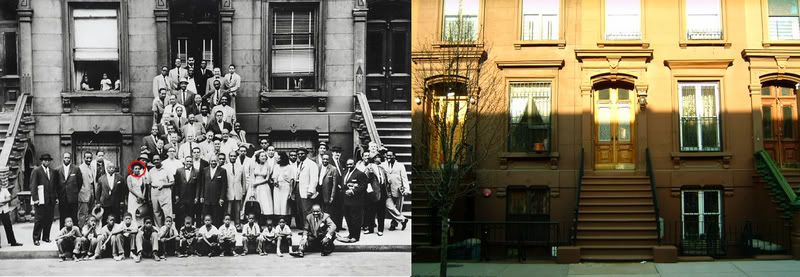
from 2/1/07 Maxine is one of 3 women in this photo. I went back to the spot to see what it looks like now. It's at 17 East 126th Street.
"A Great Day in Harlem or Harlem 1958 is a 1958 black and white group portrait of 57 jazz musicians photographed on a Harlem street. Art Kane, a freelance photographer working for Esquire magazine, took the picture at around 10 a.m. in the summer of 1958. The musicians had gathered on 126th Street, between Fifth and Madison Avenues in Harlem, New York City.
Esquire published the photo in its January 1959 issue. Jean Bach, a radio producer of New York, recounted the story behind it in her 1994 documentary film, A Great Day in Harlem. The film was nominated in 1995 for an Academy Award for Documentary Feature. The photo was also the centre of the plot for Steven Spielberg's film, The Terminal, starring Tom Hanks as Viktor Navorski, who comes to the United States in search of Benny Golson's autograph to complete his father's collection of autographs by the jazz musicians pictured in the classic 1958 photo.

Maxine Sullivan: The Folks Who Live On The Hill


from 1/31/07 from pseudo-intellectualism
How fitting. This great Kern tune, with one of my all time favorite lyrics ( Hammerstein). Maxine sung it with Claude Thornhill's band over 60 years ago. It foreshadowed her own little house on the hill in the Bronx
Many men with lofty aims,
Strive for lofty goals,
Others play at smaller games,
Being simpler souls.
I am of the latter brand;
All I want to do,
Is to find a spot of land,
And live there with you.
Someday we'll build a home on a hilltop high,
You and I,
Shiny and new a cottage that two can fill.
And we'll be pleased to be called,
"The folks who live on the hill".
Someday we may be adding a thing or two,
A wing or two.
We will make changes as any fam'ly will,
But we will always be called,
"The folks who live on the hill".
Our veranda will command a view of meadows green,
The sort of view that seems to want to be seen.
And when the kids grow up and leave us,
We'll sit and look at the same old view,
Just we two.
Darby and Joan who used to be Jack and Jill,
The folks like to be called,
What they have always been called,
"The folks who live on the hill".

Maxine Sullivan: Her House On 818 Ritter Place

from 1/31/07 from pseudo-intellectualism
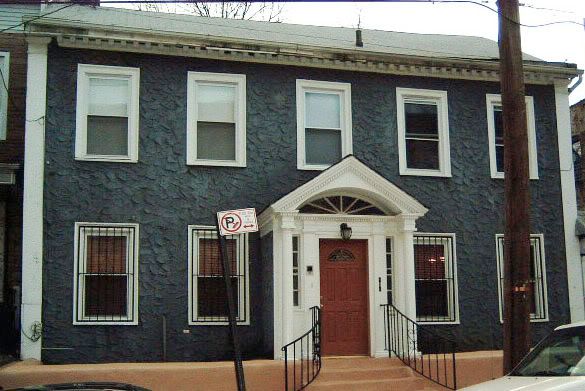
After reading this article I had to go take a picture of this piece of history
Step Into the Attic. Enter the Jazz Age.
By BERNICE YEUNG, nytimes

In the spring of 2004, a tall and trim 31-year-old real estate developer and investor from Harlem named Ed Poteat received a call from a broker about a hot deal in the Morrisania section of the Bronx.
The broker was calling about a Neoclassical building on Ritter Place dating from the early 20th century that was going on sale. The house was small but attractive, its charcoal gray stucco set off by white-trimmed windows and white columns flanking the front door. Mr. Poteat crunched some numbers, dispatched an agent to survey the building and within 48 hours had agreed to buy the property for $150,000.
For Mr. Poteat and his business partners, it was a typical transaction, so much so that not until the fall did he even bother to block out a space in his busy calendar to make his first visit to the house.
When he arrived that crisp September day, Paula Morris, the seller, was on hand to give him a tour. As they strolled through the musty rooms, Mr. Poteat admired the oak paneling in the dining room, the hardwood floors and the hand-carved detailing that appeared throughout the house and gave it a cozy, rustic feel. Upstairs, Mr. Poteat marveled at the carved door frames leading to three large bedrooms.
Then Ms. Morris, a nurse who favors African prints in her dress and has a short, caramel-colored Afro, led Mr. Poteat up a narrow staircase to the attic. There, milk crate upon milk crate brimming with papers and photographs was stacked nearly to the ceiling. Perhaps sensing his bewilderment, she explained that her mother had been a famous jazz singer, and that these were her things.
Down in the dining room, Mr. Poteat noticed a poster-size photograph hanging on the wall. It was a reprint of Art Kane’s iconic 1958 image, “A Great Day in Harlem,” showing 57 legendary jazz musicians posed in front of a brownstone.
As Mr. Poteat remembers the moment, Ms. Morris pointed a finger at one of the three women in the photo and announced: “That was my mother right there. Her name was Maxine Sullivan.”
Mr. Poteat, who was a young teenager when the singer died in 1987, had never heard of Ms. Sullivan. But he knew that if she was included in the Art Kane photograph, she must have been a jazz luminary, and that her papers, even in such a messy and disorganized state, might constitute a forgotten chapter in music history.
Seventy years ago, in 1937, Ms. Sullivan left her small Pennsylvania town and first strode onto a New York stage. During the ensuing 50 years she climbed to the heights of jazz — and before Mr. Poteat lay the record of that long journey, in at least three dozen stacked milk crates.
The Unused Ticket
In interviews given before her death, Maxine Sullivan liked to tell the story of how the pint-size daughter of a barber from Homestead, a small town near Pittsburgh, achieved international acclaim as a jazz singer.
During her late teens, after winning local singing contests and performing with her uncle’s band, she landed a gig at an eight-table former speakeasy in Pittsburgh called the Benjamin Harrison Literary Club. Singing from table to table, she earned $14 a week plus tips.
One night in late 1936, a pianist named Gladys Mosier came by the club and encouraged Ms. Sullivan to try her singing where it really mattered, in New York. It took Ms. Sullivan six months to save up enough for a weekend excursion ticket, and she told no one that she was going, figuring that she’d probably be back in Pittsburgh in time for her regular engagement.
“I was innocent enough to figure that things would happen that fast,” she told the author Arnold Shaw during an interview for a 1971 book, “The Street That Never Slept.”
Ms. Sullivan never used that return ticket. On her first day auditioning in clubs along West 52nd Street, then known as Swing Street and the subject of Mr. Shaw’s book, she landed a job at the famous Onyx Club, singing for a group led by John Kirby — who eventually became the second of her four husbands. Ms. Sullivan got her big break almost immediately, and her ascent within the music industry was equally swift. In her first week in New York, she made her debut recording with the Claude Thornhill Orchestra, and it was Mr. Thornhill who, in August 1937, suggested that she do a swing rendition of the Scottish folk song “Loch Lomond.” The song catapulted Ms. Sullivan to international acclaim.
Hollywood came calling, too. The next year, Ms. Sullivan appeared in “Going Places” with Louis Armstrong and a pre-presidential Ronald Reagan, and in 1939 she was in “St. Louis Blues” with Lloyd Nolan and Dorothy Lamour. Also that year, Ms. Sullivan made it to Broadway with “Swingin’ the Dream,” a jazzman’s take on “A Midsummer’s Night’s Dream.”
By 1940, she and Mr. Kirby were performing weekly on a national radio program called “Flow Gently Sweet Rhythm.” They were among the first black jazz musicians to do so.
In the next decade, Ms. Sullivan performed at the Village Vanguard and the supper club Le Ruban Bleu, played one-night engagements with Benny Carter, and recorded with Decca and RCA Victor. She developed a reputation for being a reliable and savvy performer with an understated but charming performance style.
“Maxine had a very pure, sweet voice, and she had a nice time sense, but she wasn’t very theatrical,” said Dan Morgenstern, director of the Institute of Jazz Studies at Rutgers University, who knew Ms. Sullivan. “Maxine didn’t scat, but I think she had a jazz sensibility.
“One thing about Maxine was that her personality was very compatible with jazz musicians, because unlike some singers, she didn’t demand a lot of attention and she didn’t elbow the musicians out of the way. She looked at herself as one of them. She didn’t put on any airs.”
The Good Words Club
In 1957, however, Ms. Sullivan stepped away from the music industry, to devote herself full time to raising her daughter, then 12, and engaging in community activities. She joined the local school board and served as P.T.A. president, roles in which she was known by her birth name, Marietta Williams, though it didn’t take long for local residents to discover that the cheery woman who patrolled the school hallways and helped out in the cafeteria had been a renowned jazz singer.
“Her reputation in the performing arts is twin to her social consciousness,” said Jim Bartow, a jazz guitarist. “The vocal delivery, the smoothness, the ease, that’s the way she operated with everybody and everything.
“To have an interlude of being a mother and raising children and then coming back, and using her organizational skills in the community, which were legendary, having block parties, parties at her house — in hindsight, because you’re in it, and you just don’t know the good things that are happening — the quality that she represented was big time, big league, and rare.”
During those years, Ms. Sullivan’s home at 818 Ritter Place became the headquarters of her community organizing. She held neighborhood parties there, as well as meetings of a group she called the Good Words Club, in which she taught children vocabulary words and asked them to read poetry aloud to a rhythm.
Still, jazz remained a crucial part of her life. Her fourth husband, the stride pianist Cliff Jackson, recorded with J. C. Higginbotham and Dizzy Gillespie, and the couple were frequently surrounded by their musician friends. Sometimes, when the jazzmen jammed at the Ritter Place house, Ms. Sullivan wandered through the room to offer a brief melody or a lyric.
“Growing up, I never knew she was really something,” one former neighborhood kid, Samuel Christian, said in an interview with the Fordham University Bronx African-American History Project early last year. “She was just this lady with this wonderful house that I liked to go to. She had a house with a fireplace and even today, I can smell the space.”
Said her daughter: “She had a keen sense of getting people organized. Her main thing was to get the children involved.”
The couple also supported jazz musicians through a two-story house they owned nearby on Stebbins Avenue, which had been converted into a boardinghouse for musicians like the trombonist Vic Dickenson and the drummer Marquis Foster.
When Mr. Jackson died in 1970, Ms. Sullivan decided to open a jazz community center and museum dedicated to her late husband in the apartment on Stebbins Avenue. The grand opening for the space, which she called the House That Jazz Built, took place on July 19, 1975, with a party featuring the World’s Greatest Jazz Band and, naturally, Ms. Sullivan on vocals.
Even as her singing career was experiencing a revival — notable moments included her Tony Award nomination for her performance in “My Old Friends” on Broadway, performances with Buck Clayton and J. C. Higginbotham, and three Grammy nominations — her primary focus remained the House That Jazz Built.
Music and Milk Crates
After some extensive renovations, Mr. Poteat sold the little house on Ritter Place last summer. Knowing that it would soon be turned over to another owner, he decided last September to give it a quick walk-through.
Unlocking the padlocked door, he stepped into a dim and dusty entry hall. Suddenly, he remembered the memorabilia collection in the attic. He assumed that Ms. Morris had had them carted away to storage somewhere, but when he made his way up to the attic, there sat the mounds of crates.
He began to examine the boxes’ contents. There were notes written in Ms. Sullivan’s tidy hand, fading music manuscripts, bills addressed to Marietta Williams, press clippings detailing Ms. Sullivan’s career, old magazines, sealed manila envelopes and odd scraps of paper. Some items seemed to disintegrate as he touched them.
Though Ms. Sullivan’s career had ebbed and flowed over the years, this closer look at the crates made Mr. Poteat realize something: Ms. Sullivan had saved seemingly every item that came into her hands. The always-growing pile of memorabilia had come to include Mr. Jackson’s musical manuscripts, programs from performances, a letter filled with lyrics-in-progress from the ragtime pianist and jazz composer Eubie Blake, a get-well card from the bassist Milt Hinton, a congratulatory note from Ronald Reagan, and reels of audiotape from her radio appearances.
More digging revealed sealed envelopes, personal correspondence and notebooks filled with Ms. Sullivan’s ideas and plans. “The feeling that you’re going through someone’s diary, that’s the feeling I got,” Mr. Poteat said during an October visit to the memorabilia collection, as he leafed through some newspaper clippings.
In a gray duffel bag, he found a pile of photo negatives and slides of performances, including Art Blakey at the CafĂ© Society and Fletcher Henderson at the Cotton Club. “You’d need a jazz archivist to sit here and grab a week and sort through this stuff,” Mr. Poteat said.
With the impending sale of the house, Mr. Poteat wanted to return everything to Ms. Morris, but the only telephone number he had for her was the one for the disconnected phone in the Ritter Place house. Nor was she listed in the phone book.
“I think, at least I hope, that they took the most valuable personal pieces,” Mr. Poteat said. “Maybe it was just such a headache to move all this stuff.”
To put the items into safekeeping, Mr. Poteat called a moving company the next day and directed the workers to pack up the contents of the attic and transport them to the basement of an apartment building he owned in Central Harlem. Within hours, Ms. Sullivan’s teetering stack of memorabilia had found a temporary home in a basement on West 149th Street. Speaking from her new three-bedroom apartment on Frederick Douglass Boulevard near 148th Street, where she lives with her brother, Orville Williams, Paula Morris said that she had indeed put most of the collection in storage.
“It’s a lot,” Ms. Morris explained. “An attic full. First of all, you don’t know what it is. And what I might think is garbage, might be of interest to people. You just want to close your eyes and pretend it’s not there. I mean, it’s impossible. To go through one box, it’s overwhelming.”
As for the crates that had been left in the attic on Ritter Place, Ms. Morris said she had been “very busy” but was in the process of getting them back. In mid-January she said that she had “places in mind” to which to donate the collection and intended to call Mr. Poteat about moving it from his basement “within the next couple of months.” Mr. Poteat said, “I just want to make sure that it’s not in a trash heap somewhere — or in my basement.”
Wherever the papers ultimately end up, the episode turns out to be something of a tradition at 818 Ritter Place.
In 1980, Ms. Sullivan gave 15 hours of interviews for a project sponsored by the Rutgers Institute of Jazz Studies. It turns out that the jazz singer had bought the house, in 1945, from the musician Eddie Mallory, who was married to the singer Ethel Waters. Like Mr. Poteat after her, Ms. Sullivan was surprised to find that Mr. Mallory has accumulated a cache of music memorabilia at the house.
“I found a lot of Ethel Waters recordings here,” Ms. Sullivan told the Rutgers interviewer. “I think the very first recording she ever made was here, because I bought the house furnished. I have one of the first records she made of ‘Am I Blue.’ ”
The new owner of 818 Ritter, according to city property records, is also an entertainer, an up-and-coming comedian and actor named Godfrey Danchimah. Mr. Danchimah, 37, who has appeared in the films “Johnson Family Vacation” and “Zoolander,” moved in late last fall. If he ever sells the place, it will only be fitting if he leaves a few things behind.

blogger templates | Make Money Online