Thursday, February 3, 2011

John Coltrane and Edward Strickland on Coltrane

Edward Strickland is famous in Knickerbocker Village history
an excerpt from an article Strickland wrote about Coltrane in the Atlantic

What Coltrane Wanted
The legendary saxophonist forsook lyricism for the quest for ecstasy
by Edward Strickland
JOHN COLTRANE died twenty years ago, on July 17, 1967, at the age of forty. In the years since, his influence has only grown, and the stellar avant-garde saxophonist has become a jazz legend of a stature shared only by Louis Armstrong and Charlie Parker. As an instrumentalist Coltrane was technically and imaginatively equal to both; as a composer he was superior, although he has not received the recognition he deserves for this aspect of his work. In composition he excelled in an astonishing number of forms--blues, ballads, spirituals, rhapsodies, elegies, suites, and free-form and cross-cultural works.
The closest contemporary analogy to Coltrane's relentless search for possibilities was the Beatles' redefinition of rock from one album to the next. Yet the distance they traveled from conventional hard rock through sitars and Baroque obligatos to Sergeant Pepper psychedelia and the musical shards of Abbey Road seems short by comparison with Coltrane's journey from hard-bop saxist to daring harmonic and modal improviser to dying prophet speaking in tongues.
More Stars Of The Negro Leagues And Great Art

will-johnson-black-baseball
from artist will johnson's site

Tuesday, February 1, 2011

Stars Of The Negro League

judy-johnson-cards2
Shown above is the set of Judy Johnson tribute cards. One card with 5000 numbered copies is produced each season to honor a former Negro League player. The first card of the set was the Judy Johnson card issued in 1996. The cards are given away with admission to the Judy Johnson Tribute to Negro League Baseball held each August at the Wilmington Blue Rocks ballpark in Wilmington, Delaware.
Several of the honored players played for teams in the ManDak League in the 1950's and many other former Negro League players that played in the ManDak League played on the same teams with these players.
Leon Day, former ManDak League player with the Winnipeg Buffaloes, is inducted into the National Baseball Hall of Fame in Cooperstown, New York. Ted Radcliffe is a six-time Negro League all star player that played for the Elmwood Giants. Bill Cash was a catcher for the Bismarck Barons in 1955. Satchel Paige was the greatest Negro League pitcher. He is enshrined in the National Baseball Hall of Fame. He was a Minot Mallard for their first three games in 1950.
The cards are illustrated by Michael D. Mellet and produced by the Judy Johnson Foundation. The cards are 6 inches by 8 inches. The back side of the cards gives biographical information.

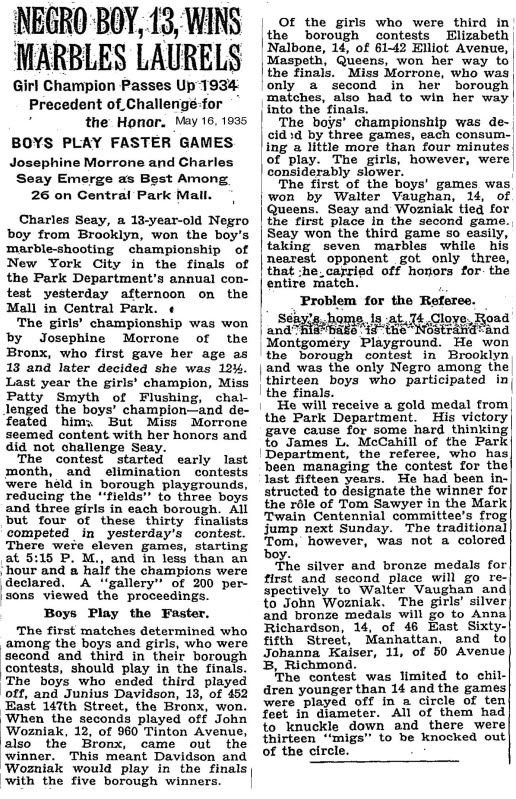
Charles Seay: NYC Marbles Champion 1935

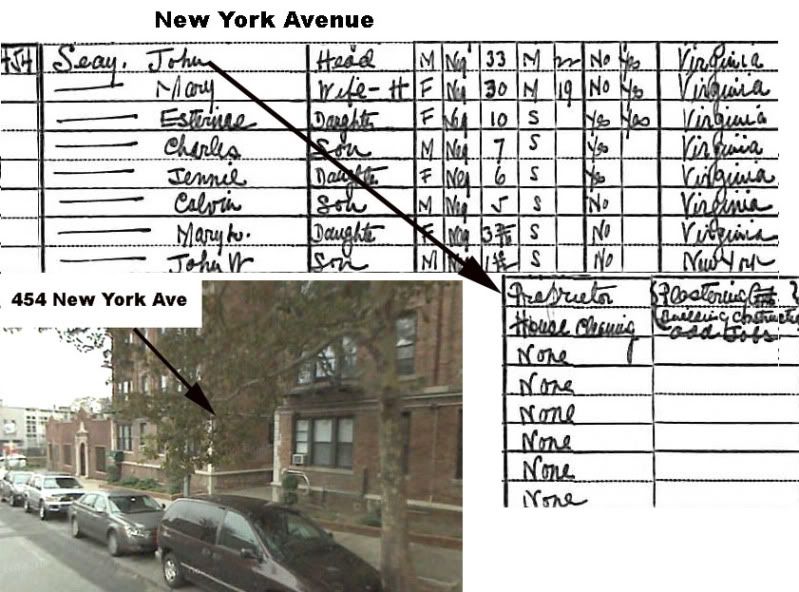
Note the "hard thinking" of James McCahill of the Parks Dept. I don't know where 75 Clove Road is in Brooklyn, but James must have lived in Crown Heights. In 1930 his family lived at 454 New York Avenue. I wonder what ever happened to Charles Seay?

Herbert Hill: NAACP Labor Lawyer

herbert-hill                                                            

Herbert Hill (January 24, 1924 – August 15, 2004) was the labor director of the National Association for the Advancement of Colored People for decades and was a frequent contributor to New Politics (magazine) as well as the author of several books. He was later Evjue-Bascom Professor of Afro-American Studies and Industrial Relations at the University of Wisconsin–Madison and eventually emeritus professor. He played a significant role in the civil rights movement in pressuring labor unions to desegregate and to seriously implement measures that would integrate African Americans in the labor market. He was also famous for his belief that American trade unions had downplayed the history of racism that tarred their reputations, before and after the Jim Crow era.
Hill earned a B.A. from New York University in 1945 and attended the New School for Social Research from 1946 until 1948 where he studied under the distinguished political theorist, Hannah Arendt. During the 1940s, Hill was a member of the Socialist Workers Party. Hill (although white) was appointed Labor Director of the NAACP in 1951 where he worked until 1977 when he departed for a professorship at the University of Wisconsin–Madison. He was highly critical of the practice of nepotism in many unions whereby relatives of members were hired. Hill criticized labour relations practices in numerous industries including the film industry as well as the progress of the Kennedy Administration on issues of racial equality in the workplace. Among the many unions he criticized for their record on racial equality were the International Ladies Garment Workers Union, the United Auto Workers, the United Federation of Teachers and the United Steelworkers of America as well as the AFL-CIO federation itself. Hill particularly objected to the AFL-CIO position that Title VII of the 1964 Civil Rights Act should not interfere with existing seniority systems. He was also a strong supporter of affirmative action. According to a New Politics article by Stephen Steinberg, Supreme Court Justice Thurgood Marshall once described Hill as "the best barbershop lawyer in the United States".
He also organized pickets to raise awareness of racial discrimination in the construction industry. His conduct was so controversial that some unions threatened to withhold funding of the NAACP unless Hill was fired, but the NAACP leadership under Roy Wilkins supported Hill. Hill published over one hundred articles in journals, anthologies and newspapers and was also known for debates with labor historian Herbert Gutman as well as debates in New Politics (magazine) with union leader Al Shanker and Nelson Lichtenstein, an academic and biographer of Walter Reuther. Hill was especially sharp against Lichtenstein's support for the allegedly racist Reuther and the UAW's activities to betray the civil rights movement. He also served as a consultant for the Equal Employment Opportunity Commission and the United Nations.
One of the most important campaigns led by Hill was his campaign against the discriminatory practices of the ILGWU. Despite the fact that the ILGWU had cooperated with the NAACP with respect to desegregation of union locals in the South, as late as the early 1960s, there were still no African-American nor Puerto Rican officers or executive board members in the ILGWU in its New York City base. The ILGWU was of particular importance because of its major role in the Liberal Party of New York. Hill played a key role in taking on a complaint against Local 10 of the ILGWU of an African American cutter, Ernest Holmes, who had been repeatedly prevented from joining the cutters' union, thereby receiving lower wages and denied the health and welfare benefits associated with union membership. Hill alleged that the ILGWU restricted African American and Puerto Rican workers to low paying jobs. In 1962, the New York State Commission for Human Rights found that Local 10 had violated the state antidiscrimination law. The ILGWU launched a public relations campaign alleging partisanship on the part of the Republican appointed Commission in response and did little to solve the problem. Writing in New Politics (magazine), a leading ILGWU official, Gus Tyler, attempted to show that there were African Americans and Puerto Ricans in the union. Adam Clayton Powell Jr. held Congressional hearings in the House Committee on Education and Labor on the ILGWU practices in 1962. Hill testified at the hearings, criticizing David Dubinsky for his governance of the ILGWU. Even though Hill was Jewish, allegations of anti-semitism were made with respect to the NAACP critique of the ILGWU. Changes to the ILGWU only came about slowly, especially after the retirement of Dubinsky in 1966.

Monday, January 31, 2011

The Tainted History Of The ILGWU

Crisis Herbert Hill                                                            

Thursday, January 13, 2011

The San Juan Hill Section Of Manhattan

an excerpt from the nytimes
IT’S 7:30 on a weekday evening, and the Josie Robertson Plaza at the heart of Lincoln Center is crowded. Slender teenagers from Juilliard’s ballet program, hair still up in tight “bunhead” knots, dart like gazelles toward the New York State Theater, where City Ballet is about to perform. They cut through the older operagoers flowing toward the Metropolitan Opera House. Film fans stroll diagonally across the plaza, heading to the Walter Reade Theater.
The mood is cooler at Jazz at Lincoln Center nearby in the Time Warner Center. In Dizzy’s Club Coca-Cola, musicians play against the backdrop of the club’s wall of windows, offering patrons at the bar and small tables a spectacular view of Columbus Circle at night.
This kind of activity has characterized the neighborhood since the 1960s. But long before President Dwight D. Eisenhower broke ground for the Lincoln Center performing arts complex in 1959, the area from Columbus Circle through the neighborhoods called Lincoln Square and San Juan Hill was already something of an arts center. Jazz and opera and rock ’n’ roll, Shakespeare and Ibsen and musical theater, the visual arts and the invention of the Charleston all happened there.
Lincoln Square, the area from Columbus Circle and West 59th Street up to West 72nd Street, between Central Park and the Hudson River, is now thick, and becoming thicker, with giant middle-class residential complexes and soaring commercial towers. Lincoln Center is undergoing a rebuilding, including extensive renovations to Alice Tully Hall and the Juilliard. The goal is completion in 2009.
In the early 20th century, however, Lincoln Square’s streetscapes hugged the ground with rows of tenements and brownstones, punctuated by warehouses and industrial lofts. Its residents were mostly working class and poor, with a notable contingent of artists and bohemians. On its eastern fringe stood a variety of theaters and music halls.
Squeezed into the middle, roughly from 59th to 65th Streets between Amsterdam Avenue and the 11th Avenue railroad tracks, was San Juan Hill, one of the largest black neighborhoods in Manhattan before the rise of Harlem.
On an icy, blustery December morning, I toured San Juan Hill with the historian Marcy Sacks, author of “Before Harlem: The Black Experience in New York City Before World War I” (University of Pennsylvania Press, 2006). We stood outside two of the neighborhood’s last old houses, 242-244 West 61st Street, with new construction looming beside them.
In the early 1900s the reformer Mary White Ovington observed that San Juan Hill’s “tall, monotonous tenements” were “the worst type which the city affords.” Up to 5,000 people lived jammed into a single block; beds were often used in shifts, shared by boarders.
Ms. Sacks explained that the neighborhood might have been named to honor the United States Army’s black 10th Cavalry, which fought at the battle of San Juan Hill during the Spanish-American War in 1898.
But, she said, “the more accepted story is that it really reflected the violence and the tension that were going on constantly in this neighborhood between black residents of San Juan Hill and the Italians to the north and the Irish to the south in Hell’s Kitchen.”
A century ago that fighting was constant, from small territorial skirmishes along the black-white dividing lines to full-scale street warfare. “Race Rioters At It Again,” read a headline in The New York Times in 1905; “Bullets and Bricks Fly in Race Riot,” read another, in 1907.
At the same time, “there was a great and thriving night scene going on in San Juan Hill,” Ms. Sacks said. “In the basements of a lot of tenements were clubs that ranged from really cheap dives to higher-level, higher-scale clubs.” They included poolrooms, saloons, dance halls and bordellos. “On any given Friday or Saturday night there could be some major partying happening,” she said.
In 1913 the pianist James P. Johnson was playing at a West 62nd Street club called the Jungles Casino. Black sailors and dock workers from the nearby waterfront, many of them from the Carolinas and other Southern coastal states, frequented the club and did what Johnson later recalled as “wild and comical” dances. One particular style inspired him to write an accompanying song.
In 1923 Johnson’s musical revue “Runnin’ Wild” had its premiere at the Colonial Theater on Broadway between West 62nd and 63rd Streets, site of the Harmony Atrium since 1979. It featured the song and dance from the Jungles Casino that became synonymous with the Roaring Twenties: the “Charleston.”
The New Colonial also brought Fred and Adele Astaire to its stage and, in 1910, Charlie Chaplin, performing in a British farce, “The Wow-Wows.”
Phil Schaap, the jazz historian and curator of Jazz at Lincoln Center, said jazz took a big leap in popularity in January 1917, when the Original Dixieland Jazz Band (also spelled “Jass” at the time) came from Chicago to play at Reisenweber’s Cafe, one of the large, popular lobster palaces of the era, which stood at the southwest corner of West 58th Street and Eighth Avenue.
“Within two weeks the lines went all the way down to 50th Street,” Mr. Schaap said. The band recorded songs for the Victor Talking Machine Company (precursor to RCA Victor) on Feb. 26. A week later the record was released, he said. “And before the month of March 1917 was over, it sold a million copies.”
Later, beginning in the mid-1940s, the neighborhood was a crucible of bebop. On the north side of West 66th Street between Central Park West and Columbus Avenue, a block now dominated by the offices of the ABC network, stood the Lincoln Square Center, where Dizzy Gillespie, Charlie Parker, Max Roach and others played. On the same block was the St. Nicholas Arena. It was mostly for boxing matches but, Mr. Schaap noted, “Charlie Parker played dances there, and he made the legendary record ‘Bird at St. Nick’s’ there on Saturday, Feb. 18, 1950.”
A few years later the disc jockey Alan Freed, who had brought his radio show from Cleveland to WINS, played host to his first New York City “Rock ’n’ Roll Jubilee Ball” at the St. Nick on Jan. 14 and 15, 1955. Fats Domino, the Moonglows, the Harptones and others performed for 6,000 teenagers each night.
San Juan Hill was home to a few jazz giants. The Phipps Houses, still standing at 233-247 West 63rd and 234-248 West 64th Street between Amsterdam and West End Avenues, were completed in 1912. The buildings, model tenements, were financed by the philanthropist Henry Phipps, friend and partner to Andrew Carnegie, to help alleviate the neighborhood’s slum conditions.
Thelonious Monk, born in North Carolina in 1917, was a child when his family moved into the Phipps Houses. He stayed there most of his life and was often seen roaming local streets, a quiet and distant man lost in thought. ...

blogger templates | Make Money Online