To the colleagues from whom I've learned so much about social studies and black history as well as how to teach over the years, starting out in Ocean Hill Brownsville in 1968. To the late Nancy Brezenoff, Jane Miller Monastersky, Rafael Guzman and Elaine King. To Francis Lippette, Teddy and WanLing Vann, Miguel Figueroa, and Ida Watson.
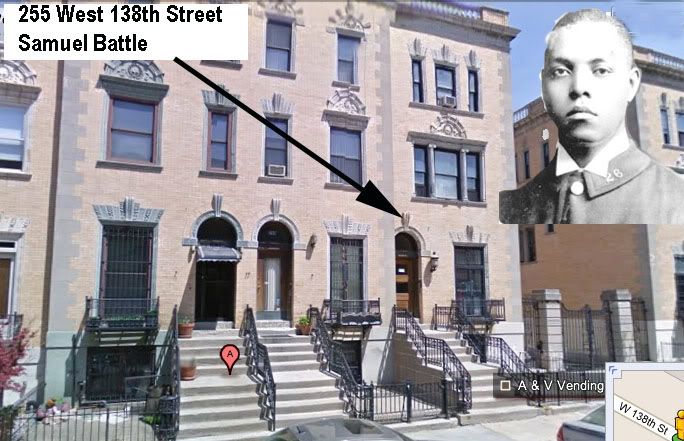
On June 28, Samuel Battle, a 6-foot-2, 285-pound 28-year-old who lived in Clinton (now known as Hell’s Kitchen), began his duties as Greater New York’s first black police officer (two who served the former city of Brooklyn had been absorbed into the metropolitan force earlier).
Appointed by Commissioner Rhinelander Waldo, Battle recalled:
My friends, and some that were not friends, said it was ridiculous: that I could never be appointed because of my color. But I said that what one could do another could, and was not willing to admit any inferiority. I stuck to it and got the appointment on my merits.
Samuel Jesse Battle (b. January 16, 1883 in New Bern, North Carolina) (died August 7, 1966) was the first black police officer in the city of Brooklyn, later New York City. After attending segregated schools in North Carolina, Battle moved north, first to Connecticut, then to New York City, where he took a job as a train porter and began studying for the New York City Police Department civil service exam. He was sworn in on March 6, 1911.
His brother-in-law was Patrolman Moses P. Cobb, who started working for the Brooklyn Police force in the early 1890s before the unification of NYC and acted as Battle's mentor. "Big Sam" as he was known - 6'3", / 280 pounds, earned the respect of his fellow Officers after saving ones life in the early 1920s. They subsequently voted to allow him into the Sargent's academy. As the NYPD's first black Lieutenant, during the intense Harlem Riots of 1935 - after 3 days of violence he circulated fliers of himself with the young boy smiling who had allegedly been murdered in the basement of the Kress Department store.
He joined the force in 1911, assigned first to San Juan Hill, the neighborhood where Lincoln Center is today, which preceded Harlem as one of the key African American neighborhoods in Manhattan. He was soon moved to Harlem, as the African American population there grew. He would later become the first African American police sergeant (1926), lieutenant (1935), and the first African American parole commissioner (1941).
In 1941, Battle began work as a parole commissioner, working with delinquent youths in Harlem. He initiated rehabilitation programs, such as summer camps and sports activities for the youth of Harlem. During a 1943 race riot, triggered by the shooting of an African-American suspect by a white police officer, Battle, at the request of New York Mayor Fiorello LaGuardia, was called in to quell the Harlem area where the riot erupted. Battle retired as parole commissioner in 1951 but remained active in community activities for the Harlem area.
* On August 4, 2009, the intersection of West 135th St and Lenox Avenue in Harlem was officially renamed in his honor.
The Cuban Giants were the first African-American professional baseball club.
The team was originally formed in 1885 at the Argyle Hotel, a summer resort in Babylon, New York. The team was so skilled in the game, and achieved victory over so many of the nearby amateur "white" teams that they attracted the attention of a promoter, Walter Cook. To appeal to a broader audience, Cook styled them the "Cuban Giants," a common ploy to avoid referring to the players as "black" or "Negro." There were no Cubans on the Cuban Giants. The team remained one of the premier Negro league teams for nearly 20 years.
The team went on to become the "world colored champions" of 1887 and 1888, and spawned imitators.
Though there were no actual Cuban men on the Cuban Giants, the team had played in Cuba in the fall or winter of 1885–1886.
In the September 1938 issue of Esquire Magazine, Sol White recounts the early days of the team: "…when that first team began playing away from home, they passed as foreigners—Cubans, as they finally decided—hoping to conceal the fact that they were just American Negro hotel waiters and talked a gibberish to each other on the field which, they hoped, sounded like Spanish" (Coover, 3).
It was a popular practice in the Sporting press at the time to refer to African-American players as Cuban, Spanish, or Arabian instead of admitting to the truth.
In 1896 ownership issues would lead to a new offshoot team being created, calling themselves Cuban X-Giants. The older owner's team was then referred to as Genuine Cuban Giant or Original Cuban Giants.
There are two different tales on how the Cuban Giants got their start. According to Sol White, a player who would join the Cuban Giants several years after they got started, Frank P. Thompson, a headwaiter at the Argyle Hotel in Babylon, Long Island, would regularly play baseball with the other waiters that soon became an attraction for the hotel’s guests. Before long, he signed 3 star players from the semi-pro black team, the Philadelphia Orions, and the team went on the road to contend any team who would play them.
However, according to an interview with Thompson himself published on October 15, 1887 in the "New York Age," an African-American newspaper, the majority of the ballplayers did not come from the hotel's staff, but from several other black teams. In Philadelphia, Frank P. Thompson organized the Keystone Athletics in May 1885, and in July they were transferred to Babylon, L.I. By August the Athletics had partnered with the Manhattans from Washington, D.C. and the Philadelphia Orions, and it was the coming together of these three teams that created the Cuban Giants. Walter Cook from Trenton, New Jersey was their white owner and Stanislaus Kostka Govern was their black manager.
Govern, who was a native of St. Croix, Virgin Islands, understood how a team could financially prosper in the Caribbean at this time. His own team, the Manhattans, had been playing in Cuba since 1882. Thompson had a connection to Henry Flagler through Osborn D. Seavey, and once the team was through with their Cuban winter tour, they came to St. Augustine, Florida to entertain the guests at the newly forming resort hub.
The Cuban Giants would come back to Florida many times during their existence. During the St. Augustine years, Thompson put together an organization called the Progressive Association of the United States. Thompson was the president of the Association, and Govern acted as secretary. Thompson used his position to conduct annual sermons for the Cuban Giants and any citizens who wanted, to come together against prejudice in the South. These sermons were widely well received and inspired others to join him in the cause.
In 1886, Walter E. Simpson bought the team and gave them a home at the Chambersburg Grounds in Trenton, New Jersey. Two months later, he would sell the team to Walter I. Cook.
Cook came from a wealthy family and was generous to the team with his money, especially when it came to illness or injuries, and he is known as the Giant’s most well-liked owner. They even played a benefit game for him in which they donated their pay to him. J.M. Bright purchased the Cuban Giants from Cook in June 1887. Bright was able to get them into the Middle States League in 1889, as joining a league was something the team had been trying to do for some time. However, Bright was not nearly as well-liked as Cook, and had to deal often with renegade players. This would be the teams last year in Trenton. In 1890 the entire team fled and played as the Colored Monarchs of York, Pennsylvania. In 1891, the heart of the team fled to their rival, Ambrose Davis’ Gorhams of New York City, then called the Big Gorhams.
This dismantling and reassembling of the team became routine year after year until 1896, when E.B. Lamar Jr. from Brooklyn bought the team from Bright, renaming them the Cuban X-Giants. Bright responded by putting together an inferior team calling them the “Genuine Cuban Giants” or the “Original Cuban Giants.” The Cuban X-Giants had a successful ten year run as one of the best black teams in the East.
In 1885, the year of the inception of the Cuban Giants, Henry Flagler built the Ponce de Leon Hotel in St. Augustine, Florida. Many members of the Cuban Giants worked at the hotel and played exhibition games as entertainment for the patrons of the hotel (Malloy). This is a point of contention, because some people say that the Cuban Giants actually worked at the hotel and began their baseball careers as something fun to do after they got off work, and others say that they didn't actually play at the hotel until their team was actually established. What is known though is that "playing for the wealthy clientele that frequented Flagler's empire kept the team afloat until they headed... to... Trenton, New Jersey" (Heaphy 16).
During their first summer season, 1886, the Cuban Giants played a game at a field in Trenton, NJ. At the time, Trenton did not have a hometown baseball team. The Cuban Giants gladly took the space, and Trenton became their “home base” (Malloy). Soon after moving to Trenton, a man named Walter Cook took over the job of booking games for the team. Cook also established salaries for the players (Heaphy 16). Walter Cook used the position that the player filled to determine how much they earned. The average pay for pitchers and catchers was about $18.00 per week, plus expenses. Outfielders made about $15.00 per week, and infielders made about $12.00 per week. These salaries were much more money than African Americans could have expected to make in a regular job at the time (Heaphy 16). Today, these salaries seem very low. In 2006, the minimum baseball player’s salary was $380,000, while the average salary was $2,699,292 (mlbplayers.mlb.com).
“The Giants…played a number of winters in Havana, Cuba” (Heaphy 17). The Giants had discovered that the key to being financially stable was to play baseball all year round. Cuba was a perfect place for them to play their winter seasons, because they could avoid the cold temperatures that were common in New Jersey in the winter, and they drew huge crowds when they played in Havana. They were so popular in fact that they played “…in front of as many as 15,000 fans” (Heaphy 17). This is very impressive for the late 19th century, considering that the average attendance per game for the Philadelphia Baseball Grounds, a popular baseball venue at the time, in 1890 was 2,231 per game (baseball-statistics.com).
Some of the prominent players were:
* Ben Boyd
* Frank Grant, infield
* Abe Harrison, shortstop
* Andrew Jackson
* Oscar Jackson
* William Jackson
* John Nelson, pitcher
* William Selden, pitcher
* Arthur Thomas
* Sol White, infield
* Clarence Williams (baseball player), catcher
* George Williams (Negro Leagues infielder), infielder and captain
ON a fine September night in 1946, in a ballpark out on the marshy edge of Newark’s East Ward, the Newark Eagles — one of the two professional baseball teams, one black and one white, that shared Ruppert Stadium — trotted onto the field in jerseys so new and bright they looked almost incandescent under the lights.
The players were black, the uniforms white. The team’s co-owner, Effa Manley, had just spent $700 on a new set, about as much as she paid her best players each month. It was the Eagles’ first time in the Negro World Series, and she wanted them to look the part of champions.
The stands were packed with both dignitaries and ordinary fans, black and white alike, and the field was dense with players on their way to the National Baseball Hall of Fame: Monte Irvin, Larry Doby, Leon Day and Manager Biz Mackey for the Eagles; Satchel Paige, Hilton Smith and Willard Brown for the Kansas City Monarchs. Conspicuously missing was the Monarchs’ shortstop from the previous season, Jackie Robinson, who was playing for the Brooklyn Dodgers’ farm club in Montreal, and was on the verge of rendering moot this whole segregated enterprise.
Sitting in the stands was an old ballplayer, creeping up on 90, who lived at the Y.M.C.A. in nearby Orange, N.J., Ben Holmes. He had brought along a treasure from the earliest days of black baseball: a silver ball awarded in 1888 to the team he played third base for, the Cuban Giants, the first full-time professional black baseball team, when they won an earlier version of the black championship. The heavyweight champion Joe Louis threw out the silver ball to start the game, the opener of the World Series.
“The ’46 series, that’s really the crème de la crème,” said Lawrence D. Hogan, a history professor at Union County College, in Cranford, N.J., and the author of a definitive book on black baseball, “Shades of Glory: The Negro Leagues and the Story of African-American Baseball” (National Geographic, 2006). He has trolled through old records and memorabilia for decades, but Holmes’s silver ball has remained elusive, as if it — like the Negro leagues themselves — disappeared from the earth soon after that series.
“There’s never been any sighting of that ball,” Dr. Hogan said. “It’s the holy grail of black baseball.”
Baseball is thriving today on the outskirts of New York, with a crop of minor-league teams and bustling new stadiums that grew quickly over the last decade or so. But these new teams were planted in fertile ground, inheritors of a rich regional tradition of black baseball — of an era when an archipelago of green diamonds stretched from Bacharach Park in Atlantic City to the Argyle Hotel in Babylon on Long Island to Bulkeley Stadium in Hartford. That was a time when much of America still believed that blacks and whites shouldn’t be neighbors or schoolmates, co-workers or teammates.
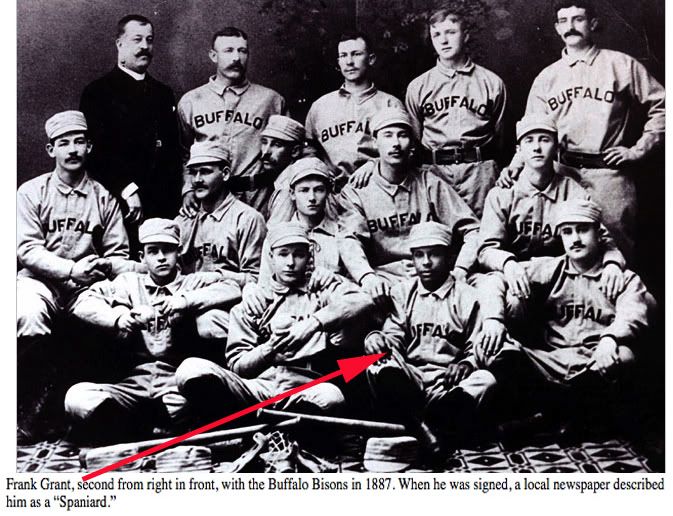
In 1886, the Buffalo Bisons, a top minor league baseball team, signed a versatile infielder from Massachusetts named Frank Grant. The next day, a local newspaper announced Grant’s arrival by describing him as “a Spaniard.”
Grant was in fact one of five African-Americans playing in the otherwise all-white minor leagues that year, on teams from Kansas to Connecticut. Their presence was accepted if not widely acknowledged in the 1880’s, passed off with a wink and a nod, a dodge that labeled players like Grant as Spaniards, Portuguese or Arabs.
The ruse did not hide what historians now concede, that some 60 years before Jackie Robinson famously broke organized baseball’s color barrier, integrated teams of white and black athletes played hundreds of professional games. African-Americans even played in the major leagues.
To most Americans, the history of black baseball means the Negro leagues, an enterprising, culturally rich response to the Jim Crow-era segregation in professional baseball. But blacks played professional baseball for decades after the Civil War, long before the Negro National League began in 1920.
On Sunday in Cooperstown, N.Y., the National Baseball Hall of Fame and Museum will induct by special election 17 stars and team owners who predate modern professional baseball’s integration in the mid-1940’s.
Two of the special inductees, Grant and a onetime teammate, Sol White, trace their baseball lives to the most obscure period of black baseball — the 1880’s, the last decade before the game imposed its color barrier.
The recently documented life stories of Grant and White, 19th-century pioneers who dared not be recognized as such, have helped complete the chronicle of the African-American baseball experience. Theirs are the forgotten tales of men rushing to play at the highest professional tier, aware that their immediate offspring would probably be prohibited such an opportunity.
“They are the players who just vanished from baseball’s narrative, like a secret no one talks about,” said the baseball historian Jim Overmyer, who specializes in black baseball. “But it is important to know that they are the beginning of baseball desegregation. Somebody had to do the early heavy lifting, and even if few people know it, these guys were there first.”
Overmyer and another historian of black baseball, Greg Bond, were among 12 members of a committee that voted for the Hall of Fame’s special election.
“It complicates our understanding of race relations in sports to realize that the color barrier was not a natural outcome of mixing races after the Civil War,” Bond said. “The fact is there were a lot of blacks on mostly white teams. The color barrier became a choice people made at the expense of people like Grant and White, who then disappeared.”
The first black professional baseball player is believed to be John Fowler, who used the nickname Bud and played for minor league teams in Lynn and Worcester, Mass., in 1878. Through recommendations from fans, historians and Hall of Fame members, Fowler was among 94 candidates for the special election, but he was not among the final 17.
Through meticulous work, representatives for the Society for American Baseball Research discovered that Fowler was born John Jackson 20 years earlier in central New York, and that he learned to play baseball, in of all places, the village of Cooperstown during the 1860’s.
Fowler played for 18 years in 13 professional leagues, from New England to New Mexico. He was a speedy base stealer who played every position, including pitcher..
Over the last several years I have digitized a great deal of content related to Social Studies and Black History. In most cases I have used QuickTime Movies as a means to deliver that content. I found that it was a more engaging way to approach the elementary and junior high school students I taught in New York City public schools. I'm pretty much retired now after close to 40 years. To construct these movies I relied on an application called LiveSlideShow. It allowed me to easily combine images, sound and text. The exported movies it created were relatively small in size, especially compared to movies created with iMovie. I have also relied on QuickTime Pro. Often the movies gave students a "taste" of a specific topic which would make it easier for them to move on to learn more on their own and do independent research. Fortuitously these slide show movies were easily converted to the format required by youtube, itunes mp4's and google video. I decided to put the Black History themed movies all in one spot rather than in the anarchic way they had existed in my other sites. I've supplemented them with other videos I discovered and then converted from youtube. More: 1. I've made available for download some of the many posterized collages that I cobbled together in PhotoShop. They are great for display along with accompanying guided questions. In order to print them (unless you are lucky enough to have a plotter) you have to have knowledge of Image Ready in order to create slices that you can piece together. 2. There are also entries for downloadable black history themed coloring pages that I've also digitized so that they may be colored in by any paint program as well as by hand. Look for the coloring pages label. 3. Many entries involve the use of primary documents, such as census reports. Look for the primary document label. 4. There are entries that make use of downloadable assignments in template form. Look for the corresponding label. 5. There are entries that make use of graphic organizers, often generated by Inspiration. Look for the corresponding label. 6. Entries may be labeled with "Google Maps." These show portions of the several Google Map Sites I've made of different neighborhoods of New York City. They will show the locations of various houses and/or locations where Black History may have occurred. 7. The are entries that contain panoramic movies I've made of various Black History related sites in New York City.

 Posts