Sunday, February 24, 2008

Duffield Place


The above film clip is from September of 2007.
An update from a December story from the mccbrooklyn blog

According to the Brooklyn Eagle, the city has pledged that it will not use eminent domain to condemn 227 Duffield Street, one of the seven sites on Duffield said to be part of the historic Underground Railroad .
The city, in a settlement filed on Friday, agreed to allow Joy Chatel to retain ownership of her home on Duffield Street. Sources told the Eagle that the city most likely wants to avoid a long, messy legal battle that would delay the construction of a public plaza and parking garage planned there as part of the Downtown Brooklyn Redevelopment Plan.
Oddly enough, one hand of the City recently co-named Duffield Street "Abolitionist Place" in honor of its Underground Railroad past, while the other hand had been steadfastly trying to demolish many of the homes thought to be part of this past.
According to Develop, Don't Destroy Brooklyn, a press conference -- to be attended by a slew of representatives, advocates and others -- is slated to be held Monday at noon in front of the Chatel home.

Friday, February 22, 2008

Google Maps: Floyd Patterson


from wikipedia:

Floyd Patterson (January 4, 1935 – May 11, 2006) was an American heavyweight boxing champion. At 21, Patterson became the youngest man to win the world heavyweight championship. He had a record of 55 wins 8 losses and 1 draw, with 40 wins by knockout. Born into a poor family in Waco, North Carolina, Patterson was the youngest of eleven children and experienced an insular and troubled childhood. His family moved to Brooklyn, New York, where Floyd was a truant and petty thief. At age ten, he was sent to the Wiltwyck School for Boys, a reform school in upstate New York, which he credited with turning his life around. He stayed there for almost 2 years.
At age fourteen he started to box, trained by Cus D'Amato at his Gramercy Gym. Aged just 17, Patterson won the Gold medal in the 1952 Helsinki Olympics as a middleweight. 1952 turned out to be a good year for the young Patterson; in addition to Olympic gold Patterson won the National Amateur Middleweight Championship and New York Golden Gloves Middleweight championship.
By the 1950s, Patterson was a resident of Rockville Centre, New York.[1]
Patterson's amateur record over 44 fights was 40-4, with 37 knockouts.
Patterson carried his hands higher than most boxers, in front of his face. Sportswriters called Patterson's style a "peek-a-boo" stance.
Patterson turned pro and steadily rose through the ranks, his only early defeat was an eight-round decision to former light heavyweight champion Joey Maxim on June 7, 1954, at the Eastern Parkway Arena in Brooklyn, New York.
Although Patterson fought around the light heavyweight limit for much of his early career, he and manager Cus D'Amato always had plans to fight for the heavyweight championship. In fact, D'Amato made these plans clear as early as 1954, when he told the press that Patterson was aiming for the heavyweight title.[2] However, when Rocky Marciano announced his retirement as heavyweight champion of the world on April 27, 1956, Patterson was ranked by Ring magazine as the top light heavyweight contender. At the time of Marciano's announcement, Jim Norris of the International Boxing Club stated that Patterson was one of the fighters who would take part in an elimination tournament to crown Marciano's successor. Ring then moved Patterson into the heavyweight rankings, at number five.
After beating Tommy "Hurricane" Jackson in an elimination fight, Patterson faced light heavyweight champion Archie Moore on November 30, 1956, for the world heavyweight championship. He beat Moore by a knockout in five rounds, and became the youngest world heavyweight champion in history, at the age of 21 years and 10 months. As a result, he was the first Olympic gold medalist to win a heavyweight title.
After a series of defenses, Patterson met Ingemar Johansson of Sweden, in the first of three fights. Johansson triumphed over Patterson on June 26, 1959, with the referee Ruby Goldstein stopping the fight in the third round after the Swede had knocked Patterson down seven times. Johansson became that country's first world heavyweight champion, thus becoming a national hero in Sweden as the first European to defeat an American for the title since 1933.
Patterson knocked Johansson out in the fifth round of their rematch on June 20, 1960, with a left hook to become the first man to recover the world's undisputed heavyweight title. Johansson hit the canvas with a thud, out before he landed flat on his back. With blood trickling from his mouth, his glazed eyes staring up at the ring lights, and his left foot quivering, the Swede was counted out. Johansson lay unconscious for five minutes before he was placed on a stool brought into the ring. He was still dazed and unsteady fifteen minutes after the knockout as he was helped out of the ring. With this win, Patterson became the first man in the history of boxing to regain the world heavyweight championship.
A third fight between them was held on March 13, 1961, and while Johansson put Patterson on the floor, Patterson retained his title by a knockout in six to win a wild rubber match in which Patterson was decked twice and Johannson once in the first round.
Some of the more questionable opponents he faced as Champion, including 1960 Olympic Champion Pete Rademacher fighting in his first professional match, led to charges that Patterson was ducking number one contender Sonny Liston. Patterson, stung by the criticism, agreed to fight Liston.
After one more defense, Patterson lost his title on September 25, 1962, by a knockout in the first round to Liston. The two fighters were a marked contrast. In the ring, Liston's size and power proved too much for Patterson's guile and agility. Ten months later on July 22, 1963, Patterson attempted to become the first boxer ever to win the world's heavyweight title three times, but Liston once again knocked him out in the first round.
Following these defeats, Patterson went through a depression, often donning sunglasses and hats to disguise himself in public. However, he eventually recovered and began winning fights again, including victories over Eddie Machen and George Chuvalo. Patterson became the number one challenger for the title now held by Muhammad Ali. On November 22, 1965, in yet another attempt to be the first to win the world's heavyweight title three times, Patterson lost by technical knockout at the end of the 12th round. Despite this loss, Patterson was still a legitimate contender. In 1966 he traveled to England and knocked out British boxer Henry Cooper in just four rounds at Wembley Stadium. In comparison, Ali never scored a knockdown against Cooper in two fights with the Britisher. In September of 1969 he divorced his first wife Sandra Hicks Patterson. She wanted him to quit boxing. He was not ready to quit yet, he knew he could get another chance at the title.
The World Boxing Association staged an eight-man tournament to determine Ali's successor. Patterson lost a controversial twelve round decision to Jerry Quarry in 1967. Then Patterson, in a third and final attempt at winning the title a third time, lost a controversial fifteen-round referee's decision to Jimmy Ellis in Sweden despite breaking Ellis' nose. This fight also included a disputed Patterdown knockdown of Ellis. Patterson went on, defeating Oscar Bonavena in a close fight over ten rounds in early 1972. However, a final defeat to Muhammad Ali in a rematch for the North American Boxing Federation heavyweight title on September 20, 1972, convinced Patterson to retire at the age of 37.
In retirement, he and Johansson became good friends who flew across the Atlantic to visit each other every year, and he became chairman of the New York State Athletic Commission. He was also inducted into the International Boxing Hall Of Fame.
In 1982 and 1983 he ran the Stockholm Marathon together with Ingemar Johansson.
Patterson lived in New Paltz, New York for many years and was known as a true gentlemen around town. He was a Latin Rite Catholic convert and a member of the Knights of Columbus.
His adopted son, Tracy Harris Patterson, was a world champion boxer in the 1990s and was trained by Floyd during part of his career. The New Paltz High School football field was named "Floyd Patterson Field" in 1985.

Jackie Robinson: Opening Day


from npr from 4/13/07

April 15, 1947, marked the most important opening day in baseball history. When Jackie Robinson stepped onto the diamond that afternoon at Ebbets Field, he became the first black man to break into major-league baseball in the twentieth century. World War II had just ended. Democracy had triumphed. Now Americans were beginning to press for justice on the home front -- and Robinson had a chance to lead the way.He was an unlikely hero. He had little experience in organized baseball. His swing was far from graceful. And he was assigned to play first base, a position he had never tried before that season. But the biggest concern was his temper. Robinson was an angry man who played an aggressive style of ball. In order to succeed he would have to control himself in the face of what promised to be a brutal assault by opponents of integration.In Opening Day, Jonathan Eig tells the true story behind the national pastime's most sacred myth. Along the way he offers new insights into events of sixty years ago and punctures some familiar legends. Was it true that the St. Louis Cardinals plotted to boycott their first home game against the Brooklyn Dodgers? Was Pee Wee Reese really Robinson's closest ally on the team? Was Dixie Walker his greatest foe? How did Robinson handle the extraordinary stress of being the only black man in baseball and still manage to perform so well on the field? Opening Day is also the story of a team of underdogs that came together against tremendous odds to capture the pennant. Facing the powerful New York Yankees, Robinson and the Dodgers battled to the seventh game in one of the most thrilling World Series competitions of all time. Drawing on interviews with surviving players, sportswriters, and eyewitnesses, as well as newly discovered material from archives around the country, Jonathan Eig presents a fresh portrait of a ferocious competitor who embodied integration's promise and helped launch the modern civil-rights era. Full of new details and thrilling action, Opening Day brings to life baseball's ultimate story.

Thursday, February 21, 2008

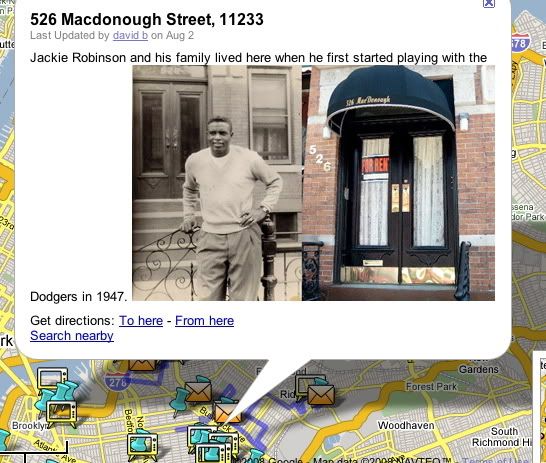
Google Maps: Jackie Robinson


from my google map of Homes of Famous Brooklynites and Other Places of Interest

Max Roach


A tribute video from youtube user dorton39
from wikipedia. It appears I share a birthday with this great man.

Maxwell Lemuel Roach (January 10, 1924 – August 16, 2007) was an American jazz percussionist, drummer, and composer.
A pioneer of bebop, Roach went on to work in many other styles of music, and is generally considered one of the most important drummers in history. He worked with many of the greatest jazz musicians, including Dizzy Gillespie, Charlie Parker, Miles Davis, Duke Ellington, Charles Mingus, Sonny Rollins and Clifford Brown.
Roach also led his own groups, and made numerous musical statements relating to the civil rights movement of African-Americans.
Roach was born in the Township of Newland Pasquotank County, North Carolina, which borders the southern edge of the Great Dismal Swamp, to Alphonse and Cressie Roach. Many confuse this with Newland Town in Avery County. Although Max's birth record lists his birth date as January 10, 1924, (Max has been quoted] by Phil Schaap as stating that his family believes he was born on January 8, 1924. His family moved to Brooklyn, New York when he was 4 years old. He grew up in a musical home, his mother being a gospel singer. He started to play bugle in parade orchestras at a young age. At the age of 10, he was already playing drums in some gospel bands. As an eighteen year-old fresh out of Boys' High School, Brooklyn, NY, (1942) he was called to fill in for Sonny Greer, and play with the Duke Ellington Orchestra performing at the NY Paramount Theatre.
In 1942, Roach started to go out in the jazz clubs of the 52nd Street and at 78th Street & Broadway for Georgie Jay's Taproom (playing with schoolmate Cecil Payne).
Roach's most significant innovations came in the 1940s, when he and jazz drummer, Kenny Clarke, devised a new concept of musical time. By playing the beat-by-beat pulse of standard 4/4 time on the "ride" cymbal instead of on the thudding bass drum, Roach and Clarke developed a flexible, flowing rhythmic pattern that allowed soloists to play freely. The new approach also left space for the drummer to insert dramatic accents on the snare drum, "crash" cymbal and other components of the trap set.
By matching his rhythmic attack with a tune's melody, Mr. Roach brought a newfound subtlety of expression to his instrument. He often shifted the dynamic emphasis from one part of his drum kit to another within a single phrase, creating a sense of tonal color and rhythmic surprise. The idea was to shatter musical conventions and take full advantage of the drummer's unique position. "In no other society", Roach once observed, "do they have one person play with all four limbs."
Virtually every jazz drummer plays in that manner today, but when Clarke and Mr. Roach introduced the new style in the 1940s, it was a revolutionary musical advance. "When Max Roach's first records with Charlie Parker were released by Savoy in 1945," jazz historian Burt Korall wrote in the "Oxford Companion to Jazz," "drummers experienced awe and puzzlement and even fear." One of those awed drummers, Stan Levey, summed up Mr. Roach's importance: "I came to realize that, because of him, drumming no longer was just time, it was music."
He was one of the first drummers (along with Kenny Clarke) to play in the bebop style, and performed in bands led by Dizzy Gillespie, Charlie Parker, Thelonious Monk, Coleman Hawkins, Bud Powell, and Miles Davis. Roach played on many of Parker's most important records, including the Savoy 1945 session, a turning point in recorded jazz.
He was given a MacArthur Foundation "genius" grant in 1988, cited as a Commander of the Order of Arts and Letters in France, twice awarded the French Grand Prix du Disque, elected to the International Percussive Art Society's Hall of Fame and the Downbeat Magazine Hall of Fame, awarded Harvard Jazz Master, celebrated by Aaron Davis Hall, given eight honorary doctorate degrees, including degrees awarded by Medgar Evers College, CUNY, the University of Bologna, Italy and Columbia University[ While spending the later years of his life at the Mill Basin Sunrise assisted living home, in Brooklyn, Max was honored with a proclamation honoring his musical achievements by Brooklyn borough president Marty Markowitz.
There is a park in the Lambeth borough of London named after him.

Lena Horne


A short clip from the 1943 movie "Cabin In The Sky"
Stormy Weather lyrics

Don't know why, there's no sun up in the sky
Stormy weather, since my man and I ain't together
Keeps raining all the time
Life is bare, gloom and misery everywhere
Stormy weather, just can't get my poor old self together
I'm weary all the time, the time, so weary all of the time
When he went away, the blues walked in and met me
If he stays away, old rocking chair will get me
All I do is pray, the lord above will let me
walk in the sun once more
Can't go on, everything I had is gone
Stormy weather, since my man and I ain't together
Keeps raining all the time
Keeps raining all of the time
I walk around heavy-hearted and sad
Night comes around and I'm still feeling bad
Rain pourin' down, blinding every hope I had
This pitter andd n patter and beating, spattering driving me mad
Love, love, love, love, the misery will be the end of me
When he went away, the blues walked in and met me
If he stays away, old rocking chair will get me
All I do is pray, the lord above will let me
Walk in the sun once more
Can't go on, everything I had is gone
Stormy weather, since my man and I ain't together
Keeps raining all the time, the time
Keeps raining all the time

Wednesday, February 20, 2008

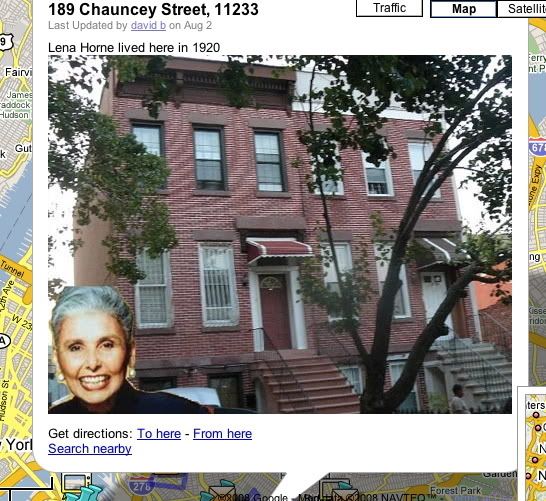
Google Maps: Lena Horne


from my google map of Homes of Famous Brooklynites and Other Places of Interest
from wikipedia

Helena Mary Calhoun Horne (born June 30, 1917), is a singer and actor of African-American, Caucasian, and Cherokee descent. She has recorded and performed extensively, independently and with other jazz notables, including Artie Shaw, Teddy Wilson, Billy Strayhorn, Duke Ellington, and Charlie Barnett. She currently lives in New York City and no longer makes public appearances.
Lena Horne was born in Bedford-Stuyvesant, Brooklyn, New York, and grew up in an upper middle class black community. Her father, Edwin "Teddy" Horne, who worked in the gambling trade, left the family when she was three. Her mother, Edna Scottron, was the daughter of inventor Samuel R. Scottron; she was an actress with an African American theater troupe and traveled extensively. Horne was mainly raised by her grandparents, Cora Calhoun and Edwin Horne. Her uncle, Frank S. Horne, was an adviser to Franklin Delano Roosevelt. She is a reported descendant of the John C. Calhoun family .
Lena Horne made her film debut starring as "the Bronze Venus" in The Duke is Tops, a 1938 musical.
After a false start headlining a 1938 musical race movie called The Duke is Tops, Horne became the first African American performer to sign a long-term contract with a major Hollywood studio, namely Metro-Goldwyn-Mayer. She made her debut with MGM in 1942's Panama Hattie and became famous in 1943 for her rendition of "Stormy Weather" in the movie of the same name (which she made while on loan to 20th Century Fox from MGM).
She appeared in a number of MGM musicals, most notably Cabin in the Sky (also 1943), but was never featured in a leading role due to her race and the fact that films featuring her had to be reedited for showing in southern states where theaters could not show films with African American performers. As a result, most of Horne's film appearances were stand-alone sequences that had no bearing on the rest of the film, so editing caused no disruption to the storyline; a notable exception was the all-black musical Cabin in the Sky, though even then one of her numbers had to be cut because it was considered too suggestive by the censors. In Ziegfeld Follies (1946) she performs "Love" by Hugh Martin and Ralph Blane.
She was originally considered for the role of Julie LaVerne in MGM's 1951 version of Show Boat (having already played the role when a segment of Show Boat was performed in Till the Clouds Roll By) but Ava Gardner was given the role instead (the production code office had banned interracial relationships in films). In the documentary That's Entertainment! III Horne stated that MGM executives required Gardner to practice her singing using recordings of Horne performing the songs, which offended both actresses (ultimately, Gardner ended up having her singing voice overdubbed by another actress for the theatrical release, though her own voice was heard on the soundtrack album).
By the mid-1950s, Horne was disenchanted with Hollywood and increasingly focused on her nightclub career. She only made two major appearances in MGM films during the decade, 1950's Duchess of Idaho (which was also Eleanor Powell's film swan song), and the 1956 musical Meet Me in Las Vegas. She was blacklisted during the 1950s for her political views.[4] She returned to the screen three more times, playing chanteuse Claire Quintana in the 1969 film Death of a Gunfighter, Glinda in The Wiz (1978), and co-hosting the 1994 MGM retrospective That's Entertainment! III, in which she was candid about her treatment by the studio. In her later years, Horne also made occasional television appearances - generally as herself - on such programs as The Muppet Show (where she sang with Kermit the Frog) and Sanford and Son in the 1970s, as well as a 1985 performance on The Cosby Show and a 1993 appearance on A Different World.
She appeared in Broadway musicals several times and in 1958 was nominated for the Tony Award for "Best Actress in a Musical" (for her part in the "Calypso" musical Jamaica) In 1981 she received a Special Tony Award for her one-woman show, Lena Horne: "The Lady and Her Music". Despite the show's considerable success (Horne still holds the record for the longest-running solo performance in Broadway history), she was not inclined to capitalize on the renewed interest in her career by undertaking many new musical projects. A proposed 1983 joint recording project between Horne and Frank Sinatra (to be produced by Quincy Jones) was ultimately abandoned, and her sole studio recording of the decade was 1988's The Men In My Life, featuring duets with Sammy Davis, Jr. and Joe Williams. In 1989, she received the Grammy Lifetime Achievement Award.
The 1990s found Horne considerably more active in the recording studio - all the more remarkable considering she was approaching her 80th year. Following her 1993 performance at a tribute to the musical legacy of her good friend Billy Strayhorn (Duke Ellington's) longtime pianist and arranger), she decided to record an album largely comprised of Strayhorn's and Ellington's songs the following year, We'll Be Together Again. To coincide with the release of the album, Horne made what would be her final concert performances at New York's Supper Club and Carnegie Hall. That same year, Horne also lent her vocals to a recording of "Embraceable You" on Sinatra's "Duets II" album. Though the album was largely derided by critics, the Sinatra-Horne pairing was generally regarded as its highlight. In 1995, a "live" album capturing her Supper Club performance was released (subsequently winning a Grammy Award for Best Jazz Vocal Album). In 1998, at the age of 81, Horne released another studio album, entitled Being Myself. Thereafter, Horne essentially retired from performing and largely retreated from public view, though she did return to the recording studio in 2000 to contribute vocal tracks on Simon Rattle's Classic Ellington album.
Horne also is noteworthy for her contributions to the Civil Rights movement. In the 1940s, she sang at Cafe Society and worked with Paul Robeson, a singer who also combated American racial discrimination. During World War II, when entertaining the troops at her own expense, she refused performing "for segregated audiences or to groups in which German POWs were seated in front of African American servicemen" , according to her Kennedy Center biography. She became better known during the Civil Rights movement, participating in the March on Washington and speaking and performing in behalf of the NAACP and the National Council for Negro Women. She also worked with Eleanor Roosevelt to pass anti-lynching laws.
In 2003, ABC announced that Janet Jackson would star as Horne in a television biopic (after it was rumored for years that Whitney Houston would take the job). In the weeks following Jackson's "wardrobe malfunction" debacle during the 2004 Super Bowl, however, Variety reported that Horne demanded Jackson be dropped from the project. "ABC executives resisted Horne’s demand," according to the Associated Press report, "but Jackson representatives told the trade newspaper that she left willingly after Horne and her daughter, Gail Lumet Buckley, asked that she not take part." Oprah Winfrey stated to Alicia Keys during a 2005 interview on The Oprah Winfrey Show that she might possibly consider producing the biopic herself, casting Keyes as Horne.
In January 2005, Blue Note Records, her label for more than a decade, announced that "the finishing touches have been put on a collection of rare and unreleased recordings by the legendary Horne made during her time on Blue Note. Remixed by her longtime producer Rodney Jones, the recordings featured Horne in remarkably secure voice for a woman of her years, and include versions of such signature songs as 'Something To Live For', 'Chelsea Bridge' and 'Stormy Weather'." The album, originally titled Soul but renamed Seasons of a Life, was released on January 24, 2006.
Horne was married first to Louis Jones, by whom she had a daughter, Gail and a son, Edwin.
Lena Horne's second marriage was to Lennie Hayton, a Jewish American, from 1947 until his death in 1971. Hayton was one of the premier musical conductors and arrangers at MGM. In her as-told-to autobiography Lena by Richard Schickel, Horne recounts the enormous pressures she and her husband faced as an interracial married couple. However, she later admitted (Ebony, May 1980) that she really married Hayton to advance her career and cross the "color-line" in show business. She is also a member of Delta Sigma Theta Sorority, Incorporated.

Google Maps: Max Roach


from my google map of Homes of Famous Brooklynites and Other Places of Interest

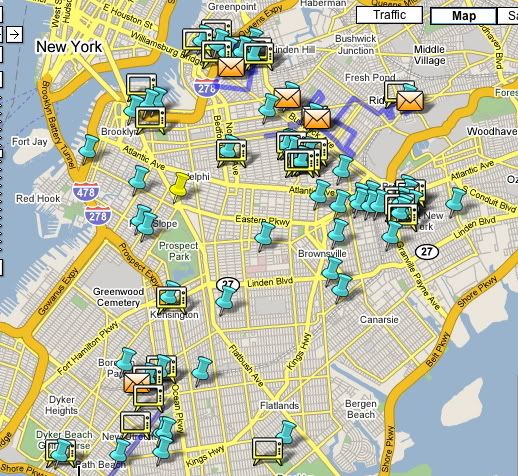
Google Maps: Brooklyn


A screen shot of and a link to my google map of Homes of Famous Brooklynites and Other Places of Interest It includes the homes of Lena Horne, Jackie Robinson, Shirley Chisholm, Eubie Blake, Max Roach and Floyd Patterson. More on this to come

Famous Brooklyn African Americans


The images are from the Brooklyn Public Library's Digital Collection. The soundtrack is Joy Spring, featuring Clifford Brown on trumpet and Brooklyn's own Max Roach on drums.
Max lived at one time at 210 Putnam Avenue in Bedford Stuyvesant

Monday, February 4, 2008

Brooklyn's Underground Railroad


On the Trail of Brooklyn’s Underground Railroad By JOHN STRAUSBAUGH
from the nytimes 10/12/07

LAST month the City of New York gave Duffield Street in downtown Brooklyn an alternate name: Abolitionist Place. It’s an acknowledgment that long before Brooklyn was veined with subway lines, it was a hub of the Underground Railroad: the network of sympathizers and safe houses throughout the North that helped as many as 100,000 slaves flee the South before the Civil War.
With its extensive waterfront, its relatively large population of African-American freemen — slavery ended in New York in 1827 — and its many antislavery churches and activists, Brooklyn was an important nexus on the “freedom trail.” Some runaways stayed and risked being captured and returned to their owners, but most traveled on to the greater safety of Canada.
Because aiding fugitives from the South remained illegal even after New York abolished slavery — and because there was plenty of pro-slavery sentiment among Brooklyn merchants who did business with the South — Underground Railroad activities were clandestine and frequently recorded only in stories passed down within families. Corroborating documentation is scarce.
Still, it’s possible to follow some likely freedom routes through Brooklyn. You begin in Brooklyn Heights, where the Promenade offers sweeping views of the East River waterfront. In the decades before the Civil War, this waterfront bristled with the masts of sailing ships. Many were cargo vessels bringing cotton and other goods from the South. Sometimes they brought secret passengers: slaves fleeing to freedom. The fugitives slipped ashore and filtered into Brooklyn, where they were hidden and helped along on their journeys. Acquiring its railroad imagery by the 1830s, this antislavery network had its own “stationmasters” and “conductors,” who helped organize runaways’ passages north, and its own “stations” and “depots,” where they hid. Several Brooklyn churches participated. Plymouth Church of the Pilgrims, a few blocks from the Promenade on Orange Street, between Hicks and Henry Streets, was called its “Grand Central Depot.” Strolling up the tree-lined street to this simple, New England-style brick church (constructed in 1849, succeeding the smaller structure that still stands behind it on Cranberry Street), it’s hard to imagine that this serene spot became a lightning rod of national debate when the Congregationalist founders invited Henry Ward Beecher to be their first preacher in 1847. Beecher, a brother of Harriet Beecher Stowe, author of the 1852 best-selling, controversial antislavery novel “Uncle Tom’s Cabin,” was both celebrated and reviled for his abolitionist stance. The archives of the Brooklyn Historical Society (nearby, at Clinton and Pierrepont Streets) contain some of the hate mail he received. One letter bears a drawing of a lynching and the note:
“Henry Ward Beecher, here is the fate of all traitors. We are making a rope for you.”
Beecher’s Sunday services packed Plymouth Church to the rafters, not just with locals but also with Manhattanites, who crossed the East River in such numbers that the ferries docking at Fulton Landing were nicknamed “Beecher Boats.“ In 1860 a long-shot presidential candidate named Abraham Lincoln paid the two-cent fare to ride a Beecher Boat to hear Beecher preach; a plaque at the end of a pew marks the spot where he sat. Walt Whitman, who was fired from his newspaper job at The Brooklyn Eagle for his abolitionist views, and who set the type for his self-published “Leaves of Grass” in a nearby print shop, was a great fan of Beecher’s sermons. Beecher also invited antislavery giants like Sojourner Truth, Frederick Douglass and Wendell Phillips to address his congregation. Other guest speakers over the years have included Booker T. Washington, Mark Twain, Charles Dickens — who read “A Christmas Carol” to capacity crowds for three nights running in 1868 — and the Rev. Dr. Martin Luther King Jr., delivering an early version of his “I Have a Dream” speech. “A lot happened in this church,” Lois Rosebrooks, the church’s director of history ministry services, said when I visited recently. “We know that this was a stop on the Underground Railroad. Charles B. Ray, an Underground Railroad conductor in Manhattan, brought people over and dropped them here. They were hidden in the church — we assume in the basement, as that would be the safest place for them.”
Beecher’s most successful tactic for arousing what he called “a panic of sympathy” for slaves was to stage mock slave auctions in the church, with the congregation bidding furiously to buy the captives’ freedom. The 1914 bronze statues of Beecher and two girls in the church’s courtyard by Gutzon Borglum, who later sculptured Mount Rushmore, depicts the first such auction, in 1848.
The most famous auction occurred in 1860, when Beecher urged his congregation to buy the freedom of a pretty 9-year-old from Washington, Sally Maria Diggs, called Pinky for her light complexion.
“After the service he called her to the platform and told the congregation her story,” Ms. Rosebrooks said. “He said, ‘No child should be in slavery, let alone a child like this.’ I’m sure he played on this. She could be your niece. She could be your sister. Your next door neighbor. So they passed the collection plate and raised $900, which is about $10,000 in today’s dollars.”
Congregants gave jewelry as well as cash. In a theatrical flourish Beecher fetched a ring from the collection plate, slipped it onto Pinky’s finger and declared, “With this ring, I thee wed to freedom.”
In 1927 when Plymouth Church celebrated the 80th anniversary of Beecher’s first sermon there, one who attended was Mrs. James Hunt, a stately woman of 76. She was Pinky and had grown up to marry a lawyer in Washington. According to Plymouth Church lore, she brought the ring with her; Ms. Rosebrooks showed me a simple gold band set with a small amethyst. (A Brooklyn Eagle article from 1927, however, quotes Mrs. Hunt as saying the ring had been lost.)
From Plymouth Church, it’s a 10-minute walk to the corner of Fulton and Duffield Streets, where the new Abolitionist Place sign hangs. The abolitionists Thomas and Harriet Truesdell lived at 227 Duffield Street in the 1850s, and William Harned, an Underground Railroad conductor, lived near Duffield and Willoughby Streets.
Even as the city unveiled the new sign, however, it was considering plans to demolish the small houses on Duffield Street as part of an economic development plan for downtown Brooklyn. New hotels, underground parking and a public square would replace much of what now stands on the block.
Joy Chatel, a cosmetologist who lives at 227 Duffield Street, and Lewis Greenstein, a retired city employee who owns 233, have fought that plan since it was announced in 2004. They believe their houses, both probably dating to the 1840s, were stops on the Underground Railroad and should be preserved.
In his sub-basement, Mr. Greenstein showed me what appeared to be a capped well and an exit shaft to the surface. Former tenants told him of finding old stoves and iron cauldrons there, since removed. It all led him to believe his house was “a feeding station” for escaped slaves passing through Brooklyn.
Ms. Chatel said that years ago she looked through an opening in a neighbor’s sub-basement to see what she thought was an abandoned subway tunnel under Duffield Street. There’s a low arch in her own subbasement, sealed with a large stone, that might lead to this tunnel.
No subway ever ran below Duffield Street. Ms. Chatel and Mr. Greenstein speculate that the tunnel was used by the Underground Railroad, and might have led toward the former Bridge Street African Wesleyan Methodist Episcopal Church, the first African-American church in Brooklyn and a known depot, just two blocks away. (It’s now Wunsch Hall of the Polytechnic University, on the Metrotech Center commons.)
Mr. Greenstein acknowledged that they have only circumstantial evidence. A planning and environmental firm commissioned by the city found no conclusive proof of their claims. The consultants made no attempt to excavate that mysterious tunnel, noting in their report that “assuming that a tunnel was discovered, there would be no way of knowing if it served as a passageway for freedom seekers without corroborating artifacts.”
Still, Mr. Greenstein said, “I think there’s enough evidence here to say, ‘Let’s do an archaeological dig.’”
From downtown Brooklyn I rode the A/C line to Utica Avenue in Crown Heights, then walked four long blocks to another cluster of small 19th-century houses enjoying a happier fate. Like a sliver of the rural past, a row of freshly painted wooden homes stands on green grass near the corner of Bergen Street and Buffalo Avenue, surrounded by modern red-brick monotony.
They’re all that remains of the African-American community of Weeksville, which thrived from the 1840s through the 1930s, then was swallowed up by Brooklyn sprawl and all but forgotten. In 1968 the last dilapidated houses were scheduled to be demolished to make way for public housing when preservationists identified and saved them. They were restored and opened for public tours as the Weeksville Heritage Center. Each house is furnished to represent a specific decade, from the 1840s — simple wooden furniture and no indoor plumbing — to the electric lights and washing machine of the 1930s. “Weeksville was founded in 1838, 11 years after the end of slavery in New York state,” Kaitlyn Greenidge, a research assistant, told me. “It was a community founded on land purchased by James Weeks, a free African-American, along with two other investors, buying land in central Brooklyn and cutting it up into plots to sell to other African-Americans.” By 1855, Weeksville was home to more than 800 residents. They included doctors, craftsmen and businessmen. Weeksville had its own elementary school, orphanage, old-age home and churches, and its own abolitionist newspaper, The Freedman’s Torchlight. Ms. Greenidge said that although Weeksville was widely known as a safe haven for African-Americans, and many blacks from Manhattan relocated there after the vicious draft riots of 1863, there was no documentation to confirm that it was a stop on the Underground Railroad. “But we do know from census records that up to 30 percent of the black people who were living in Weeksville in the 1850s had been born in the South,” she said, which suggests that at least some were escapees.
Pamela Green, Weeksville’s executive director, said its mission today is to have an impact on young people. “We want them to see that here were a group of people who were active post-enslavement, who were able to create institutions, to persevere, to create communities,” she said. “What is it about their lives that enabled them to do that in arguably one of the worst periods in history? What can you learn from what they did that will help you in facing the challenges of the 21st century?”
On Abolitionist Place, Ms. Chatel said she would like to see her house put to similar use. “There’s no black museum in Brooklyn to celebrate the Underground Railroad,” she said. “This is the house to do it in. It’s important that the children and all of the people can see what people had to go through to be free.”

blogger templates | Make Money Online