
Thursday, October 16, 2008

More Distorted History From The Santa Fe Trail, Plus A Rebuttal


I'll counter the above with this
A recent podcast done at the Gilder Lehrman Institute by historian David Reynolds

At eight o'clock on Sunday evening, October 16, 1859, abolitionist John Brown led a party of twenty-one men into the town of Harpers Ferry, Virginia, in an attempt to free slaves. The plan soon went awry. Brown was found guilty of treason, conspiracy, and murder, and was sentenced to die on the gallows. Click on the link below to read the address he gave at his sentencing:
David Reynolds, Distinguished Professor of English at the CUNY Graduate Center, reassesses the legacy of John Brown, who was hanged for his role in the October 1859 raid on the federal armory at Harper’s Ferry. Brown, a devout Calvinist possessing unshakable integrity and faith in the righteousness of his violent actions against slavery, was the only abolitionist in the years before the Civil War to live among blacks, advocate a rewritten constitution that would make slaves citizens, and ultimately to take up arms and give his life for the abolitionist cause.

A biography from the Kansas Historical Association
John Brown: May 9, 1800 - December 2, 1859, Of all the characters that played significant roles on the Kansas stage during the drama that was Bleeding Kansas, none left a legacy that compares to the controversial abolitionist, John Brown. Born in Connecticut in 1800, "Old" John Brown was only fifty-five years old when he followed his sons to Kansas just as the struggle for control of the territory was taking shape. The family settled in rural Franklin County, just southwest of Osawatomie, the home of the Rev. Samuel and Florella Adair, Brown's half-sister.
John Brown absorbed a deep hatred for the institution of slavery early in life, eventually dedicated his life to its eradication, and quickly made his presence known during the Kansas struggle. He was involved in or responsible for the "Wakarusa war" at Lawrence, the Pottawatomie Massacre, the battles of Black Jack and Osawatomie, and the liberation of dozens of slaves from nearby Missouri.
After leaving Kansas for the last time early in 1859, the crusade continued; Brown, with several of his sons and other followers, planned and conducted the ill-fated raid on the federal arsenal at Harpers Ferry, Virginia. He was tried and convicted on conspiracy, treason, and murder charges stemming from this incident and was executed on December 2, 1859.
This almost mythic figure in the history of Kansas and the nation still elicits emotional reactions from students, scholars, and the general population, and history has not always been kind to this complex personality. To some of his contemporaries, Brown was a maniacal, bloodthirsty old fanatic. To many others, black and white, he was a martyred saint. He was "a moral Genius," according to a prominent late-nineteenth-century Kansan, whose life and death "brought about the abolition of slave labor years before" it would have otherwise occurred. "No man whose name appears in the annals of Kansas can begin to stand beside John Brown."
Octobr 16th: The Anniversary Of John Brown's Raid


The final scene from Santa Fe Trail
A 1940 view of John Brown. From wikipedia:

Santa Fe Trail is a 1940 western film directed by Michael Curtiz and starring Errol Flynn and Olivia de Havilland. Despite glaring historical inaccuracies, the film was one of the top-grossing films of the year, being the seventh Flynn-de Havilland collaboration. The film also has nothing to do with its namesake, the famed Santa Fe Trail except that the trail started in Missouri. Instead, it follows the life of Jeb Stuart, a cavalry commander (and future Confederate Army general). The film purports to follow the life of J.E.B. Stuart (Errol Flynn) before the outbreak of the American Civil War. Among its sub-plots are a romance with the fictional Kit Carson Holliday (Olivia de Havilland), friendship with George Armstrong Custer (Ronald Reagan), and battles against abolitionist John Brown (Raymond Massey). One glaring inaccuracy has Stuart leading a cavalry charge against John Brown "fort" in Harper Ferry. In fact Stuart was at Harper's Ferry-but John Brown was captured in an infantry assault by US Marines under command of US Army Colonel Robert Edward Lee. Another inaccuracy is the film has Stuart, Custer, and Philip Sheridan all having been part of the West Point graduating class of 1854. In fact, Sheridan was the class of 1853, Stuart 1854, and Custer not until 1861-a year early because of the onset of the Civil War.
The movie is drastically critical of John Brown, portraying him as a bloodthirsty villain and blaming him for causing the Civil War, thereby exonerating the Confederacy for seceding. African-Americans are portrayed as practically content to be slaves and too fearful to fight with Brown in his abolitionist crusade, whereas in reality about one fourth of Brown's group were African-American. After being freed, some African-Americans in the film chant "We's free! We's free!", but later freed slaves say "We don't want it" with regards to freedom.
Massey's John Brown eagerly endorses breaking apart the union of the United States, as though abolitionism was the threat to the union rather than slavery. The movie was made on the eve of World War 2, and its tone and political subtext express a desire to reconcile the nation's dispute over slavery which brought about the American Civil War and appeal to moviegoers in both the southern and northern United States. The American Civil War and abolition of slavery are presented as an unnecessary tragedy caused by an anarchic madman. The heroic protagonists such as Flynn's Jeb Stuart and Reagan's Custer seem unable to conceive how the issue of slavery could place them at odds in the near future, even though by 1859 hostility between the pro/anti-slavery states had reached a boiling point.

Saturday, June 21, 2008

Designating W.E.B. DuBois' "Wedding" House A Queens A Landmark

Saturday, June 7, 2008

Panoramic Scene: Marcus Garvey Park

A panoramic scene linking a panorama taken from high up in the park to one at street level (to the West). Look for the "hot spots" that link the two panoramas.

Panoramic Movie Of Marcus Garvey Park

A panoramic movie taken at street level at Marcus Garvey Park (formerly Mount Morris Park-119th Street-124th Street, 5th Avenue)

Marcus Garvey Park is one of the oldest public squares in Manhattan. Central to the life of Harlem for more than 150 years, it has served as a meeting place for neighbors, a front yard and play area for schoolchildren, and a holy place for members of local churches. Known as Mount Morris Park for more than a hundred years, it was originally part of the estate of Metje Cornelius Kortright. The name Morris became attached to the site by the 1830s; possible sources include Robert H. Morris, elected mayor in 1841, and a family affiliated with a racetrack that once operated nearby.

Wednesday, May 28, 2008

NYC Slavery Tour Guide

Read this doc on Scribd: Handout 2008

Saturday, May 24, 2008

Lower Manhattan Slave History Walking Tour: 5/23/08


from Alan Singer's Website at Hofstra University

“Time to Tell the Truth About Local History, New York was a Land of Slavery”:
How Student Activism Promotes Leadership and Literacy
By Michael Pezone and Alan Singer
“Read the books and it's plain to see,
New York's the land of slavery,
If you thought the North was a freedom land,
You thought wrong -- because here you could own a man.
From Francis Lewis to Fernando Wood,
Slave labor is what was happening,
They bought and sold human beings and made their millions,
Soon the whole trade was worth more than 60 billion!
Read the books, if you don't trust me,
New York's the land of slavery.
AT&T and Citibank, just to name a few
From the slaveholding ranks,
Slaves used to be brought in all the time,
So we wanna know, JUST WHERE ARE THE SIGNS?
They tried to cover up these Northern slaves,
And if you thought it was just the South, then you got played,
Read the books, and you'll surely see,
That New York's the land of slavery.”
- India Nelson, junior, Law, Government and Community Service Magnet High School
On May 23, 2008, over six hundred upper elementary, middle-level, and high school students walked the streets of Manhattan learning about the forgotten history of slavery in New York City. It is the largest group to participate in the three-year history of the New York and Slavery Walking Tour.
There are no markers at the locations where enslaved Africans rebelled in 1712, where they plotted to win their freedom in 1741, where they were publicly executed – hung or burned at the stake -- or at the seaport where slave traders and bankers met to plan trans-Atlantic voyages. People, places, and events have been erased from the past. One of the purposes of the tour is to demand that historical markers be installed.
The New York and Slavery Walking Tour is organized by juniors and seniors from Law, Government, and Community Service Magnet High School. The population of the school is overwhelmingly African American, Caribbean, and Hispanic. Many of the students come from troubled communities and have academic difficulties. They are the survivors of less than adequate schools that produce more dropouts than graduates. They are leaders who have chosen to take ownership over their educations.
Each year, a new group of students chooses to take part in the project, a project they learn about from students who participated the previous year. They choose to become involved because they want to learn their history and the truth about American history. They also take part because they want to teach about it to the public and to other students from around the city.
Preparation takes a full school year, although the intensity picks up during the last three weeks before the tour date. The tour is in May because that is when the 1741 freedom plotters were executed in what is now New York City’s Foley Square (Singer, 2008). The square is now surrounded by courthouses, but as one tour guide explained to a group of elementary school students, “In colonial New York, there was no justice for Blacks who wanted to be free.”
In September, one of Michael Pezone’s upper-level history classes is invited to organize the tour. Because they know about it already from friends, not much persuasion is needed. But there is a lot of work to do. The class uses the New York and Slavery: Complicity and Resistance curriculum guide
www.nyscss.org.

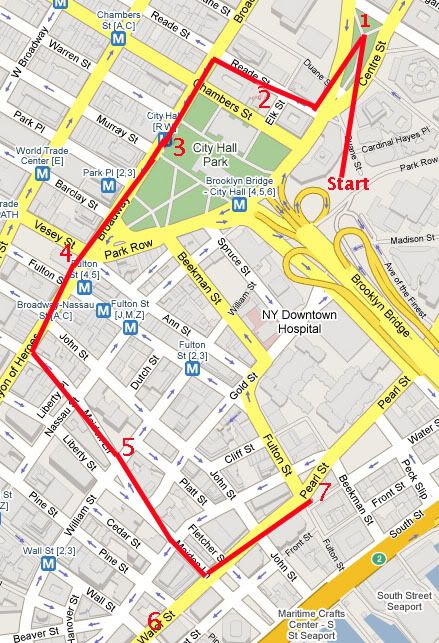
The 2008 version of the tour followed the path outlined in red. The film clip above is made of about 10 clips that were made with a Flip Video and joined together using VisualHub. There were several classes (600 students in total) from boro-wide schools that followed the 2 hour tour. The kids listened intently and took notes. Most impressive were the presentations of the enthused, knowledgeable and articulate students from Law, Government and Community Service Magnet High School in Cambria Heights, Queens,(the former Andrew Jackson High School)

blogger templates | Make Money Online